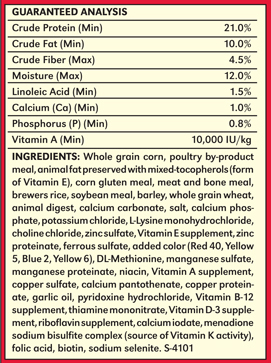
Here’s what the nutrition information on a pet food label looks like now.
Pet food labels follow the regulations for animal feed, not human food.
This might have made sense when dogs and cats were on their own to hunt or be fed household scraps, but it makes no sense at all now that pets are considered members of the family—fur babies.
The agreed-upon changes have to be incorporated into state regulations, and manufacturers need time to adopt them. Everybody gets 6 years to do this, although some companies will undoubtedly start using the new rules right away.
The changes will be in four areas of the labels:
Nutrition Facts Box – Updated to resemble human-food labeling more closely. This will be a Pet Nutriton Facts panel.
Intended Use Statement – Updated to new location on the lower-third of the front display panel to help consumers easily identify the purpose of the pet food.
Ingredient Statement – Updated to clarify the use of consistent terminology and allow parentheticals and common or usual names for vitamins.
This is a great step forward. One reason why I think so is that the new Pet Nutrition Facts label is exactly what Mal Nesheim and I recommended in our book, Feed Your Pet Right.
That book came out in 2010; these rules go into effect in 2029.
It pays to be patient—and to persist!
Marion Nestle is Paulette Goddard Professor, of Nutrition, Food Studies, and Public Health, Emerita, at New York University, which she chaired from 1988-2003 and from which she officially retired in September 2017. She is also Visiting Professor of Nutritional Sciences at Cornell. She earned a Ph.D. in molecular biology and an M.P.H. in public health nutrition from the University of California, Berkeley, and has been awarded honorary degrees from Transylvania University in Kentucky (2012) and from the City University of New York’s Macaulay Honors College (2016).
This Op-Ed by William Marler first appeared on the Marler Blog and is reposted here with the author’s permission.
Over two months ago, while watching the premiere of the documentary, “Poisoned,” at the Tribeca Film Festival in NYC, I got thinking again about how little in the past 30 years I feel I have moved the needle on food safety – pathogens and certainly, human nutrition. Now that “Poisoned” is up on the Netflix platform, it has become the most watched documentary in the world – at least for the last few days.
The real issues to me is how do we engage the food industry, policy makers, academics and most importantly consumers, to focus on driving the numbers down on the pathogens that kill us quickly and the products that kill us over time.
I will focus on pathogens as I have for the last 30 plus years. I will leave it to some very smart people who are rightly concerned about the millions of us who become sick and die due to inadequate nutrition – especially the millions of illnesses and deaths due to heart disease, diabetes and obesity caused by ultra-processed foods, salt, sugar, and fat.
There is so much to do, and the list is long. So, what would I do with a Food Safety Magic Wand on day one?
Vaccinate. The first thing I would do is mandate that all food service workers be vaccinated against hepatitis A. Perhaps to some, not the most pressing food safety issue, but it is forefront of my mind. In the past few months, I finished up litigation around a hepatitis A outbreak involving one ill food service work who infected nearly 50 people, hospitalizing most, killing four and causing two liver transplants. With regret, I forced a family-owned restaurant chain to file for bankruptcy. All of this could have been prevented by a safe vaccine that has been around for decades. It is time for the restaurant industry and the CDC to step up.
Investigate. Invest in public health surveillance over human pathogens, like, Listeria, E. coli and Salmonella, etc. A dirty truth is that most culture-confirmed illnesses are never attributable to a food source, so people never know what sickened or killed them. Not because the source was not food, but because we fail to invest adequate resources in the epidemiologists that investigate illnesses and track those illnesses to the cause. Tracking illnesses to the cause gets tainted product off the market and helps us all understand what products and producers to avoid. We need to continue to invest in the science of whole genome sequencing, so we know with certainty which pathogens are causing which illnesses. Foodborne illness epidemiology helps us understand the root cause of an outbreak and helps prevent the next one from happening at all.
Relegate. Allow public health officials access, especially during an outbreak investigation, to all areas around farms that grow fruits and vegetables. It is long past time to allow investigators access to neighboring cattle, dairy, chicken, or hog operations that spill billions of deadly pathogens into the environment, via air or water. We need to think of our growing regions as an integrated system and that all sectors responsible need to play a role. Access allows investigators to understand the likely cause of an outbreak, and again, what can be done to prevent the next one.
Advocate. Make all pathogens that can sicken or kill us adulterants. In 1994 Mike Taylor making E. coliO157:H7 and adulterant has saved countless lives and has saved the beef industry from my lawsuits. We can do the same for all food producers, especially chicken, turkey, and pork. Remember, in the 1990’s nearly all the lawsuits I filed were E. coli cases linked to ground beef. Today that is zero. Think about it.
Educate. Give everyone a thermometer and provide better education to middle and high school teachers and students around food safety and human nutrition policy, not in a dry, technical way, but by sharing engaging history, microbiology, patient stories, and case studies. We need to teach how and why our food can be unsafe and what consumers can do about it.
Consolidate. Finally, make a single federal agency out of USDA/FSIS, FDA, and the food safety parts of CDC, NOAA, and EPA, to oversee food safety and human nutrition. Making food safety and human nutrition its own agency would help increase governmental accountability, close regulatory loopholes, facilitate the collection and sharing of information and facilitate critical change. I might have a suggestion for someone to run it.
With the CDC estimating 48,000,000 are sickened each year, 125,000 hospitalized, and 3,000 die from food, preventing pathogenic foodborne illness is no simple matter. And, if you consider the millions that are impacted by the lack of adequate and safe nutrition, we have a lot to do. However, it can be done, and the six ideas above are a small start.
“Doing anything is better than doing nothing,” my Marine drill sergeant father used to say. He used to require my brother and I to make our beds every morning and bounce quarters on them. For the longest time I thought this was punishment. But it was not punishment, it was accomplishment, that you could build on for the rest of the day. Doing “little” things, like the six things above, are accomplishments. Doing them starts a process that will continue to make all our lives just a little bit safer.
Bill Marler’s work as a lawyer and food safety advocate is highlighted in the Netflix Documentary “Poisoned” now streaming.
Ground beef purchased from ShopRite locations in Connecticut, New Jersey, and New York may be the source of a multistate outbreak of Salmonella, according to a report by the US Centers for Disease Control and Prevention (CDC).
The federal agency is investigating sixteen (16) cases of Salmonella Saintpaul infections in Connecticut (1), Massachusetts (1), New Jersey (9), and New York (5).
Four of the outbreak victims have been hospitalized. There have been no deaths.
Victims range in age from less than one year old to 97 years old. Nineteen percent (19%) of the victims are children under five years of age.
Ground beef is the only common food that victims who were interviewed remembered having eaten in the days before become ill.
All of the people who remembered the type of ground beef they ate and where they bought it reported eating 80% lean ground beef purchased from ShopRite locations in Connecticut, New Jersey, and New York.
Timeline
The first victim began to experience symptoms on April 27, 2023. The most recent victim developed symptoms of Salmonella infection on June 16, 2023.
The number of reported cases is likely to grow, as it can take as long as three to four weeks for suspected cases to be confirmed as part of an outbreak.
The CDC is currently searching its PulseNet data base to check for additional hitherto unidentified outbreak cases.
In March 2023, the USDA’s Food Safety and Inspection Service (FSIS) recovered a strain of Salmonella SaintPaul closely related to the current outbreak strain in a sample of ground beef analyzed as part of a routine surveillance program.
There was no recall, as the FSIS does not consider Salmonella-contaminated raw ground beef to be adulterated.
Salmonella and raw beef
Raw beef is a common source of Salmonella illnesses.
The 27 outbreaks resulted in 1103 illnesses, 254 hospitalizations, and two deaths. The most common category of beef behind the outbreaks was raw, ground beef.
In spite of this clear connection between Salmonella illnesses and the presence of the pathogen in raw beef, the FSIS has resisted efforts over the years to name Salmonella as an adulterant in raw beef.
The agency’s position is that raw beef is meant to be cooked before being consumed, thus minimizing the risk to consumers.
USDA recommends that consumers cook raw ground beef to an internal temperature of 160ºF to ensure that any Salmonella present will be killed.
The situation is different in Europe.
The presence of Salmonella or any other foodborne pathogen in raw meat is grounds for issuance of a recall in member countries of the European Union and in the United Kingdom.
The CDC offers the following recommended practices to avoid becoming infected with Salmonella:
Clean:
Wash any bowls, utensils, and surfaces that touch raw ground beef with soap and water before using them to prepare other foods.
Wash your hands with soap and water for 20 seconds after preparing raw ground beef and before touching other kitchen items.
Separate:
When shopping, separate raw ground beef from other foods in your shopping cart and grocery bags. Place packages of raw ground beef into individual plastic bags to avoid cross-contamination.
Keep raw ground beef separate from foods that will not be cooked.
Store raw ground beef in a container or sealed, leakproof bag on the lowest shelf in the fridge or freezer.
Cook:
Use a food thermometer to make sure you have cooked meat to a temperature high enough to kill germs. Ground beef should be cooked to an internal temperature of 160°F, and leftovers should be heated to an internal temperature of 165°
Do not eat raw or undercooked ground beef.
Chill:
Raw ground beef that has been refrigerated should be used or frozen within 1 or 2 days.
Refrigerate or freeze ground beef within 2 hours of cooking. If the food is exposed to temperatures hotter than 90°F, like a hot car or picnic, refrigerate or freeze within 1 hour.
Freeze any meat that will not be used within a few days. Although freezing can help keep ground beef safe until you can cook it, it does not kill existing harmful germs.
Thaw frozen ground beef in the refrigerator, not on the counter.
Call your healthcare provider right away if you have any of these severe Salmonella symptoms:
Diarrhea and a fever higher than 102°F
Diarrhea for more than 3 days that is not improving
Bloody diarrhea
So much vomiting that you cannot keep liquids down
Signs of dehydration, such as:
Not peeing much
Dry mouth and throat
Feeling dizzy when standing up
“Reads like a true crime novel” – Food Safety News
Interested in learning more about food safety and the history of foodborne disease outbreaks and investigations?
Click on the link to listen to a short excerpt, then follow the buy links to add a digital, print or audio copy to your personal library.