Food by-product recycler fails FDA inspection

A June 2023 FDA inspection of ReConserve of Maryland, Inc. found multiple food safety and sanitation issues at the facility.

The inspection outcome was classified as “Official Action Indicated,” and a summary of the observations was posted on the FDA’s searchable inspections dashboard.

“Official Action Indicated” means that regulatory and/or administrative actions are recommended, according to the FDA’s definition of inspection classifications.

The actual actions taken by the agency will depend, at least in part, on the willingness of the company to correct each of the issues identified during the inspection in a timely manner.

ReConserve Inc. is a recycler of edible food waste, with multiple locations across the United States.

According to its website, the company recycles bakery, cereal grain, snack foods, and related food by-products into ground meal that can be incorporated into feed for poultry, swine, dairy cattle, and beef cattle.

During the course of the inspection, the FDA noted the following infractions:

  • You did not keep the grounds around your animal food plant in a condition that would protect against the contamination of animal food.
  • You did not effectively protect the animal food stored outdoors in bulk from contamination.
  • You did not inspect, segregate, or otherwise handle raw materials and ingredients used in manufacturing under conditions that will protect the animal food against contamination and minimize deterioration.
  • You did not identify and evaluate each known or reasonably foreseeable hazard for each type of animal food you manufacture, process, pack or hold in your facility.
  • You did not identify and implement preventive controls to ensure that any hazards requiring a preventive control are significantly minimized or prevented.
  • You did not conduct a reanalysis of your food safety plan as appropriate.

Why this matters

ReConserve describes its finished product as a “high-energy, nutrient dense, highly palatable” substitute for “more expensive feed grains and fat,” which can be incorporated into animal food rations at levels as high as 25% for poultry and 30% for swine.

Improper storage and handling of bakery and other cereal grain by-products can easily lead to mold growth in the material, with the potential for development of aflatoxins and other mycotoxins.

Improper or inadequate controls during and after processing could result in contamination with harmful bacteria, such as Salmonella, as a result of cross-contamination or exposure to rodent or bird infestation.

Either of these outcomes put livestock at risk.


Cronobacter to become notifiable disease in USA

The Council of State and Territorial Epidemiologists (CSTE) has approved a position statement recommending that invasive Cronobacter infection in infants be added to the list of approximately 120 notifiable diseases in the United States.

The position statement was developed by the CSTE in conjunction with the US Centers for Disease Control and Prevention (CDC), the Food and Drug Administration (FDA) and the Association of Public Health Laboratories (APHL).

The CSTE is a voting body comprised of State Epidemiologists from all U.S. states, territories, and the District of Columbia. 

The text of the statement will be released in coming weeks.

STOP Foodborne Illness, a national public health non-profit organization, hailed the announcement, predicting that the CSTE decision would have a “…meaningful impact on infant mortality.”

A look back

In February 2022, consumers were shocked to learn of four infant illnesses due to Cronobacter infections linked to consumption of powdered infant formula manufactured by Abbott Nutrition.

As the months passed and more was learned about the evolution of the contamination problem, food safety experts and members of the public began to advocate for adding Cronobacter to the list of infectious diseases reported as a matter of course to the CDC’s national surveillance database.

Notifiable versus reportable

What is a notifiable disease, and how does it differ from a reportable disease?

Although these two terms are often used interchangeably in the context of disease surveillance, they actually have quite different meanings as far as the CDC is concerned.

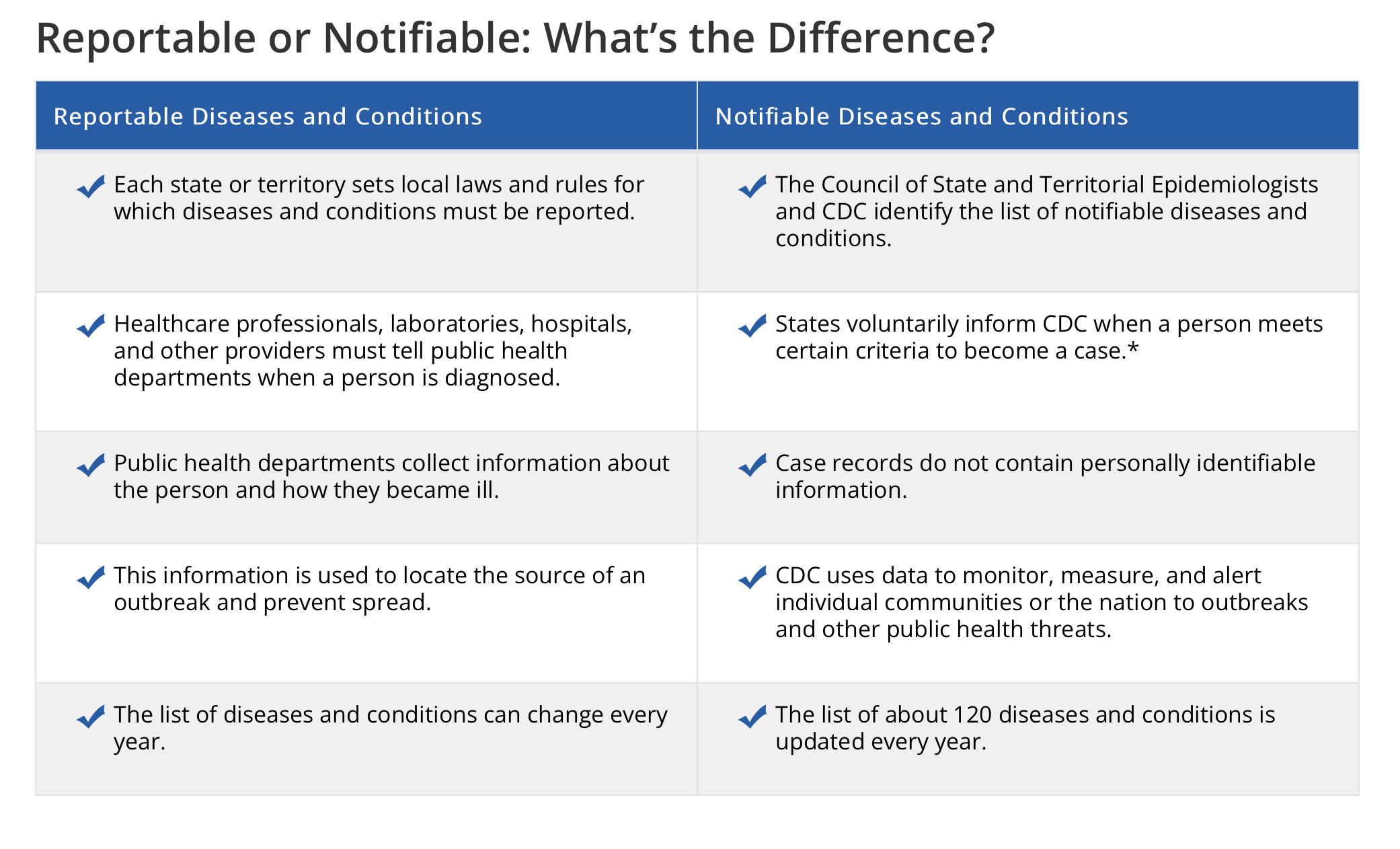
This screenshot from the CDC website explains the differences between notifiable and reportable diseases.

Reporting of notifiable disases is voluntary, and personal information is redacted from the reports that reach the CDC. The data from notifiable disease reports is useful for statistical surveillance, but cannot easily be used to locate the source of an outbreak.

On the other hand, reportable diseases (which are specified individually by each state or territory) MUST be reported to public health authorities by healthcare professionals, hospitals and laboratories. Reports supplied to the CDC in these instances contain information on the individual patients, and can be used to track the source and scope of disease outbreaks.

A notifiable disease may also be reportable by one or more states and territories, if those local authorities decide to make it so.

Under no circumstances does the CDC have the authority to MANDATE reporting of either notifiable or reportable diseases.

The bottom line

Adding invasive Cronobacter infection in infants to the list of national notifiable diseases is a long overdue action, which will improve the CDC’s ability to track trends in the frequency of this disease condition.

Let us hope that it will also spur additional states and territories to mandate reporting of Cronobacter infections to local public health authorities in their jurisdictions.


TAINTED formats 3
“Reads like a true crime novel” – Food Safety News

Interested in learning more about food safety and the history of foodborne disease outbreaks and investigations?

Click on the link to listen to a short excerpt, then follow the buy links to add a digital, print or audio copy to your personal library.

Chapter 6. Birth of a Pathogen

TAINTED is available in digital format from all major on-line retailers. Press the button to go directly to your preferred digital bookstore.


It’s Publication Day!

Calling All Pets
(and Pet Parents, Too)

Five years after the idea for a book on the pet food industry first took hold of me during a walk on Carmel Beach, I am proud to announce the official launch of TOXIC. From Factory to Food Bowl, Pet Food Is a Risky Business.

If you share your life with a companion animal—especially a dog or cat—you owe it to your pet to educate yourself about the practices that take place behind the scenes in the factories and kitchens where raw, canned, and kibbled pet foods are manufactured.

The reality behind the appetizing package labels and enticing website advertising may shock you. It will certainly disillusion you, as it did me.

The stories and investigations described in TOXIC are drawn from interviews with pet owners, public records, published articles, and FDA inspection reports. 

FULL DISCLOSURE: My husband and I are very fortunate to share our home with our 7½ year old Australian Cobberdog, Rutlands Shalom. She thrives on a home-cooked diet that I prepare for her myself.


Word On the Street

As part of the run-up to the publication of TOXIC, I supplied Advance Review copies to a number of colleagues in the writing community. Several of these individuals have already posted their reviews, and I am proud to share a few of their comments here. If you wish to read a complete review, please click on the reviewer’s name or handle.

“As the former global pathogen product manager at a major testing manufacturer, I found this book a fantastic companion to Tainted by Phyllis Entis.” – George Nagle (Amazon USA reviewer)

“TOXIC provides an eye-opening look at the pet food industry’s failures.” – Amy M. Reade (Amazon USA reviewer)

“Well, wow! As with Entis’s first book, TAINTED, this new installment is frighteningly eye opening.” – PeaceLoveHope (an Amazon USA Vine Voice reviewer)

“My thanks to the author for this meticulous insight – would that it weren’t necessary to hold those responsible constantly to account, but it is … and this book does that with aplomb.” – MeandtheMutts (Amazon UK reviewer)


A Peek Inside the Book

If you have read this far, please let me entice you further with a short excerpt from Chapter 9: Pentobarbital’s Pervasive Presence. I interviewed Mark Johnson via email for this story.

Mark was a California cattleman and his dogs were his workforce. He maintained a string of Border Collies and Australian Shepherd mixes to help with herding. Mark first purchased Gravy Train canned dog foods in 2015, using the products as supplemental feedings and as rewards for his dogs. In January 2018, when disaster struck, Mark owned thirteen dogs, ranging from ten months to approximately seven years old. One of his six female dogs was pregnant.

Typically, Mark purchased five cases of dog food weekly, patronizing the local Walmart and Big Lots stores for his supplies. In early January 2018, he replenished his supply of canned food with a purchase of two Gravy Train varieties: Chunks in Gravy with Beef Chunks, and Chunks in Gravy with T-Bone Flavor Chunks. On or about January 12th, all thirteen dogs fell sick within hours after eating the Gravy Train dog food. He took all of the dogs to his local veterinarian. Within two days of having consumed the dog food, all thirteen dogs were showing signs of kidney failure and were euthanized at the veterinarian’s recommendation.

Although the veterinarian performed a necropsy on one of the dogs, neither he nor Mark reported the dog deaths to the FDA. According to Mark, the veterinarian died shortly after the incident, and Mark was unable to retrieve his files. As of November 2018, Mark was still searching for replacement herding dogs that were in need of a good home.


How To Order TOXIC

TOXIC. From Factory to Food Bowl, Pet Food Is a Risky Business is available in digital format from all major ebook retailers, and can be purchased in paperback on Amazon. 

Alternatively, you can have your favorite bookstore order a copy of TOXIC for you.

If you prefer to borrow your reading material from a local library, please consider asking your librarian to add TOXIC to the library’s collection.