
Second Salmonella outbreak linked to sprouts

CDC, FDA silent on new multistate outbreak

September 4, 2026

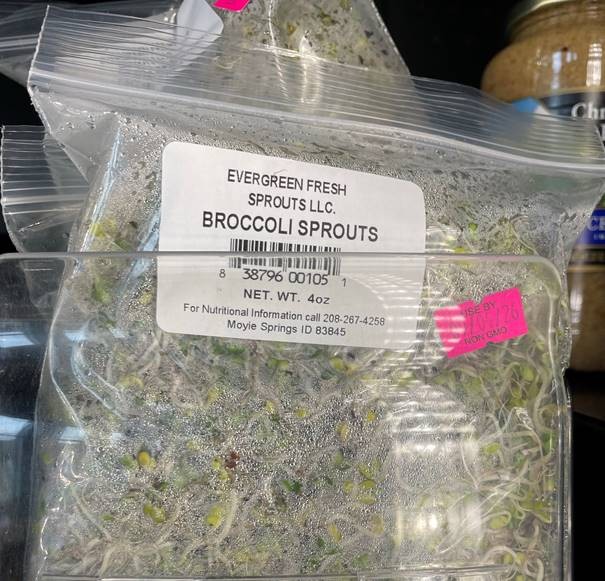
Washington, Montana, and Idaho health officials are reporting a new outbreak of Salmonella Bovismorbificans infections linked to broccoli sprouts from Evergreen Fresh Sprouts, LLC (Moyle Springs, Idaho).

The outbreak appears to be unrelated to the 15-state outbreak of Salmonella and E. coli illnesses linked to consumption of alfalfa sprouts.

Thirteen of the sixteen confirmed outbreak victims are residents of Washington state. Two of the Washington residents have been hospitalized. Outbreak cases have been reported in seven Washington counties.

Illness onset dates for the 13 Washington victims range from July 7 to August 18. Of the twelve people available for interview, eight reported eating sprouts from Evergreen Fresh Sprouts, LLC. Seven of the eight recalled eating broccoli sprouts.

Montana is reporting two outbreak victims, and one victim is from Idaho.

Outbreak victims in Washington purchased the sprouts from grocery stores, food co-ops and restaurants. Montana victims reported purchasing the sprouts in grocery stores.

Sprout samples from Evergreen and other suppliers are undergoing testing at the Washington and Montana public health laboratories.

Neither the CDC nor the FDA have released any information regarding this outbreak. It does not appear on the FDA’s weekly listing of active investigations.

As of today, there has been no recall by the firm. However, local sanitarians in Montana are contacting the stores known to have sold the sprouts to arrange for their removal from sale.

As Bill Marler noted in his report on the outbreak, this is the third time that sprouts from Evergreen have been implicated in an outbreak of Salmonella illnesses.

In 2011, alfalfa sprouts and spicy sprouts grown by Evergreen Fresh Sprouts were responsible for an outbreak of 25 cases of Salmonella Enteritidis in five states. Three people were hospitalized. In 2014, raw clover sprouts were linked to a 19-case outbreak of E. coli O121 infections in six states. Seven people were hospitalized.

As part of their investigation into the 2014 outbreak, the FDA conducted an inspection of the company’s sprouting operations. They found multiple examples of insanitary conditions, including apparent mold growth, dripping condensate, irrigation water dripping from rusty valves, and corroded areas in contact with the growing sprouts. In one example, they noted employees using tennis rackets to scoop sprouts out of the water and onto a conveyor belt.

Evergreen Fresh Sprouts, LLC has been inspected on multiple occasions by the FDA since 2010. The 2011 inspection that followed on the heels of the first outbreak resulted in the issuance of a formal FDA Warning Letter to the company. Most of the subsequent inspections, including the one performed in 2014, result in a classification of “Voluntary Action Indicated.”

The most recent FDA inspection was performed in 2024 and was classified “Voluntary Action Indicated.” However, no summary of the inspection observations has been posted on the FDA’s inspection database web page.

If you have consumed raw sprouts from whatever source and you begin to experience symptoms of gastroenteritis, contact your family physician.

Clean and sanitize any surfaces that may have come into contact with raw sprouts.

DO NOT EAT RAW SPROUTS!


TAINTED formats 3
“Reads like a true crime novel” – Food Safety News

Interested in learning more about food safety and the history of foodborne disease outbreaks and investigations?

Click on the link to listen to a short excerpt, then follow the buy links to add a digital, print or audio copy to your personal library.

Chapter 6. Birth of a Pathogen

Second possible source in outbreak linked to sprouts

Both companies share common seed supplier

August 31, 2026

Sprouts produced by Everything Sprouts, LLC do not account for all of the E. coli and Salmonella illnesses currently under investigation in a multistate outbreak that has caused 55 illnesses so far.

The FDA‘s traceback investigation has identified a second sprout grower who received seeds from the same outfit that supplied alfalfa seeds to Everything Sprouts.

The supplier has instructed its customers not to use, grow, sell, transfer, or redistribute the implicated seed lot, and to return or dispose of any remaining seed.

Neither the second sprouting operation nor the seed supplier have been named by the FDA.

The FDA has requested that the seed supplier initiate a voluntary recall of the implicated lot of seeds and also contact their customers to recommend a recall of the sprouts produced from those seeds. The supplier has not responded to the recall request, nor have they contacted their downstream customers to recommend recalls.

The FDA is continuing its investigation of both sprout producers and of the potentially contaminated lot of seeds that was supplied to both companies.

As of today, the CDC has not updated its case count, which stands at 55 confirmed cases, including 4 people hospitalized, in fifteen states. Seven of the victims were infected with Salmonella Agona, while 46 were confirmed to be infected with one of three strains of E. coli. At least two individuals suffered a double whammy—infected with both E. coli and Salmonella.

On August 28th, Everything Sprouts expanded its initial recall of three sprout products to include a fourth product due to what the FDA described as a risk of cross-contamination.

FDA recommends the following:

  • Do not eat, sell, or serve recalled sprouts. 
  • Check your refrigerators and freezers for recalled sprouts and throw them away or return the product to the place of purchase. If you froze a product without the original packaging and can’t tell if it’s part of the affected sprouts, throw it away.   
  • Consumers, restaurants, retailers, and foodservice customers who purchased or received recalled sprouts, including wholesale products, should carefully clean and sanitize any surfaces or containers that they touched. Follow FDA’s safe handling and cleaning advice to reduce the risk of cross-contamination.
  • Retailers that received recalled sprouts and repackaged them for individual sale should not sell them and should remove the products from the market. 
  • Consult your health care provider immediately if you ate recalled sprouts and have any symptoms that resemble an STEC or Salmonella infection.

eFoodAlert adds one more: AVOID RAW SPROUTS, whether or not they have been recalled.


TAINTED formats 3
“Reads like a true crime novel” – Food Safety News

Interested in learning more about food safety and the history of foodborne disease outbreaks and investigations?

Click on the link to listen to a short excerpt, then follow the buy links to add a digital, print or audio copy to your personal library.

Chapter 6. Birth of a Pathogen

Taylor Farms Cyclospora outbreak continues to grow

Georgia, Tennessee, and Texas added to list of states with outbreak cases

August 27, 2026

The number of confirmed cases in the Cyclospora outbreak linked to Taylor Farms de Mexico iceberg lettuce has reached an eye-popping 11,458 individuals in 20 states, according to an update released today by the CDC.

This represents an increase of 528 cases since the previous update, released on August 20th.

The true scope of this outbreak is almost certainly much larger than the number of lab-confirmed cases. Most people who become infected with Cyclospora develop only mild symptoms and don’t seek medical assistance.

The states of Georgia, Tennessee, and Texas have now been added to the list of affected states. All three of these states were on the FDA‘s posted list of states where the recalled lettuce was distributed.

Michigan remains the state most severely hit by this outbreak with more than 4800 cases confirmed so far; Ohio and Missouri are in second and third place, respectively. The CDC does not break down the number of hospitalizations on a state-by-state basis.

Here is a list of the affected states, in descending order by number of confirmed cases:

  • Michigan: 4846
  • Ohio: 2679
  • Missouri: 1010
  • Indiana: 823
  • Kansas: 331
  • Kentucky: 329
  • Illinois: 278
  • Pennsylvania: 244
  • Oklahoma: 241
  • Nebraska: 199
  • West Virginia: 160
  • Iowa: 130
  • Arkansas: 82
  • New Hampshire: 42
  • Texas: 20
  • Massachusetts: 18
  • Maine: 16
  • Tennessee: 5
  • Georgia: 3
  • North Carolina: 2

According to the CDC, this outbreak began (ie., initial victims became ill) on June 14 and onset dates have continued through August 15, 2026.

Of the 9,256 victims for whom an onset date is available, 1001 (10.8%) fell sick on a single day—July 10, 2026.

It can take as long as six weeks from the time an individual develops symptoms to the time the CDC is able to confirm that the person is part of the outbreak. Therefore, we can expect the case count to continue to increase, albeit more slowly, for some time to come.

On July 17, 2026, Taylor Farms de Mexico recalled shredded iceberg product distributed June 29th thru July 16th, and suspended distribution of the iceberg lettuce from Central Mexico. According to the FDA, the recalled iceberg lettuce should no longer be available for sale.

The FDA is conducting on-site inspections and sampling at iceberg lettuce growers and the Taylor Farms processing facility in Mexico in coordination with Mexican officials.

On average, people begin to develop symptoms approximately one week after they become infected with Cyclospora (range 2 days to 2 weeks).

Therefore, most of the illnesses with onset dates prior to July 5th were NOT due to consumption of the recalled lettuce, which only hit the market on June 29th.

More than one-quarter (27%) of all the cases for which an onset date is available developed before the recalled lettuce hit the market. That’s 2,525 individuals who were exposed to contaminated lettuce that was no longer available for testing by the time the CDC and the FDA realized there was an outbreak in progress and traced it to lettuce served (according to initial data) at Taco Bell.

This is a failure of surveillance, of communication between state and federal agencies, and of traceback timeliness, and is deserving—nay, demanding—of congressional investigation.


TAINTED formats 3
“Reads like a true crime novel” – Food Safety News

Interested in learning more about food safety and the history of foodborne disease outbreaks and investigations?

Click on the link to listen to a short excerpt, then follow the buy links to add a digital, print or audio copy to your personal library.

Chapter 6. Birth of a Pathogen