Listeria in Viva pet foods prompts recall

The Lewis Sausage Company, Inc. (Burgaw, NC) has recalled a single production batch of five varieties of Viva brand raw dog and cat foods due to Listeria monocytogenes contamination.

The contamination was discovered as a result of an inspection carried out by the US Food and Drug Administration (FDA). There is no indication as to what triggered the FDA inspection.

The recalled products were co-packed by Lewis Sausage on behalf of Viva Raw, LLC (Durham, NC) and were distributed by Viva Raw.

Viva Raw does not carry out any manufacturing at its location of record. The company’s address of record, as listed by the North Carolina Secretary of State, belongs to a single-family home in a residential area of Durham, North Carolina.

No press release was issued for this recall, which was initiated on June 12, 2024 and includes the following products.

  • VIVA for cats turkey (1 lb (454g); Lot #21244)
  • VIVA for dogs CHUNKED turkey (1 lb (454g); Lot #21244)
  • VIVA for dogs GROUND turkey (1 lb (454g); Lot #21244)
  • VIVA for puppies beef & turkey GROUND (1 lb (454g); Lot #21244)
  • VIVA PURE turkey for cats & dogs (1 lb (454g); Lot #21244)

The recalled products were shipped to distributors in California, North Carolina, and New Jersey.

A claim of “human-grade meat” made for a pet food product is no guarantee that the food will be pathogen-free.

The US Department of Agriculture’s Food Safety and Inspection Service (FSIS) allows the sale of raw meats and raw poultry that are contaminated with pathogens such as Salmonella and Listeria monocytogenes. Lewis Sausage is a FSIS-inspected facility (Establishment No M8001+P8001).

However, pet food manufacturers—including FSIS-inspected facilities—fall under the jurisdiction of the FDA. And the FDA maintains a zero-tolerance policy for pathogens in any animal food that is sold as “ready-to-eat” (ie., that will not by subjected to a cooking step before being fed).

The FDA relies heavily on reports from pet owners and veterinarians to alert them to safety issues with pet foods. Especially useful are reports that include veterinary information and details on the suspect food (brand, variety, batch codes, et cetera).

The following links will help you to make your report to the FDA. Just click anywhere on the blue to be taken directly to the appropriate FDA web page.

How to Report a Pet Food Complaint. Read this web page before beginning to file your complaint. It provides a list of the information you should try to have at hand before you begin to file. If you are missing some information, do not despair. Even partial information will be helpful.

Consumer Complaint Coordinators. This FDA page supplies the telephone number for the agency’s Consumer Complaint Coordinator in each state. Use this approach if you wish to make your complaint by telephone. If you do not reach a live voice, please leave a detailed message so that the coordinator can return your call.

Safety Reporting Portal. Use this FDA page if you prefer to file your report on-line with the agency. Begin by clicking on the button “Report as Guest” and continue by answering each question as it is presented to you.


“A complete and compelling account of the hidden and not-so-hidden ways the food we give our beloved pets can be contaminated.” JoNel Aleccia, Health Reporter, Food & Nutrition, The Associated Press.

“An invaluable resource for busy pet owners” – Food Safety News

Available from all major on-line retailers, including:

Salmonella Africana outbreak and the cucumber conundrum

The US Centers for Disease Control and Prevention (CDC) and the US Food and Drug Administration (FDA) are investigating two outbreaks of Salmonella infections that apparently are linked to consumption of cucumbers.

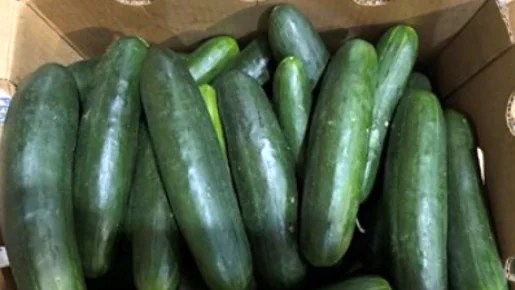
On June 1, 2024, Fresh Start Produce Sales, Inc. recalled 6167 cases of Whole Cucumbers grown in Florida after the Pennsylvania Department of Agriculture (PDA) found Salmonella in a sample of the company’s cucumbers.

Nevertheless, it is still an open question whether the cucumbers supplied by Fresh Start are the source of either or both outbreaks.

The Salmonella Africana outbreak

  • As of June 12, a total of 196 people infected with the outbreak strain of Salmonella Africana have been reported from 28 states and the District of Columbia.
  • Illnesses started on dates ranging from March 11, 2024, to May 23, 2024.
  • 68 people have been hospitalized.
  • Age of outbreak victims range from <1 to 94 years.
  • 63 out of 85 people interviewed (74%) reported eating cucumbers, as compared with 50% of individuals responding to a population survey.

The Salmonella Braenderup outbreak

  • As of June 12, a total of 185 people in multiple states were reported to be infected with the outbreak strain of Salmonella Braenderup.
  • The outbreak shares similarities with the Salmonella Africana outbreak, including where and when illnesses occurred and the demographics of ill people.
  • Investigators are working to determine whether the two outbreaks could be linked to the same food vehicle. 

The Salmonella-positive cucumber sample

  • The cucumber sample supplied by Fresh Start Produce and tested by the PDA was contaminated with Salmonella Bareilly. The strain does not match any ongoing Salmonella outbreaks.
  • The recalled cucumbers were distributed to 14 states: Alabama, Florida, Georgia, Illinois, Maryland, North Carolina, New Jersey, New York, Ohio, Pennsylvania, South Carolina, Tennessee, Virginia, and West Virginia.
  • The cucumbers recalled by Fresh Start were packed by Bedner Growers, Inc., a family-owned business. Bedner grows 1,500 acres of bell peppers and 500 acres of cucumbers in Palm Beach and Martin counties, Florida.
  • The FDA inspection database shows no record of any prior inspections of Bedner Growers by the federal agency.

Bedner is just one among many cucumber growers in the state of Florida.

The FDA and its state partners are continuing to sample cucumbers from other sources as part of the traceback investigation for both the Salmonella Africana and the Salmonella Braenderup outbreaks. However, cucumbers have a limited shelf life, and the produce responsible for the outbreaks may no longer be available for sale.

The best chance of making a definitive link to a specific grower/packer will be if the FDA is able to find one or both outbreak strains in samples obtained during an on-site inspection.

The FDA has already initiated inspection and sampling activities in conjunction with the Salmonella Africana outbreak, although the agency has not specified where the inspection is taking place. More information will be forthcoming from the FDA as it becomes available.

  • Do not eat any recalled cucumbers. If you recently purchased cucumbers and have them at home, you can check with the store where you purchased them to see if they were part of the recall. If you can’t tell, do not eat them.
  • Wash items and surfaces that may have touched the recalled cucumbers using hot soapy water or a dishwasher.
  • Call your healthcare provider if you have any of these severe Salmonella symptoms:
    • Diarrhea and a fever higher than 102°F
    • Diarrhea for more than 3 days that is not improving
    • Bloody diarrhea
    • So much vomiting that you cannot keep liquids down
    • Signs of dehydration, such as:
      • Not peeing much
      • Dry mouth and throat
      • Feeling dizzy when standing up
  • Do not sell or serve recalled cucumbers.
  • Wash and sanitize items and surfaces that may have come in contact with recalled cucumbers.
  • Stores can also notify customers who may have purchased recalled cucumbers using signs in stores or emails to customers.

TAINTED formats 3
“Reads like a true crime novel” – Food Safety News

Interested in learning more about food safety and the history of foodborne disease outbreaks and investigations?

Click on the link to listen to a short excerpt, then follow the buy links to add a digital, print or audio copy to your personal library.

Chapter 6. Birth of a Pathogen

TAINTED is available in digital format from all major on-line retailers. Press the button to go directly to your preferred digital bookstore.

Posting about to resume, with a few changes

Dear eFoodAlert readers and subscribers,

I am pleased to announce that eFoodAlert will resume regular posting of recalls and alerts later today, with a few changes.

A review of the demographics of our readership has made it clear that approximately 90% (or more) of readers and subscribers are based in the United States, Canada, and the United Kingdom. In order to free up some time and energy, I have decided to limit my posts to recalls and alerts from English-speaking countries.

To assist those among you who are interested in recall notifications from European countries whose web sites are not published in English, a list of live links to various national recall sites will appear on each Recalls & Alerts post.

Recall posts will appear every Monday, Wednesday, and Friday as before. I shall continue to monitor and report on various food safety issues, outbreak investigations, and pet food issues as they arise.

On a personal note, I very much appreciate your messages of support and good wishes during this recent difficult time. Thank you.

Phyllis Entis (aka The FoodBugLady)