
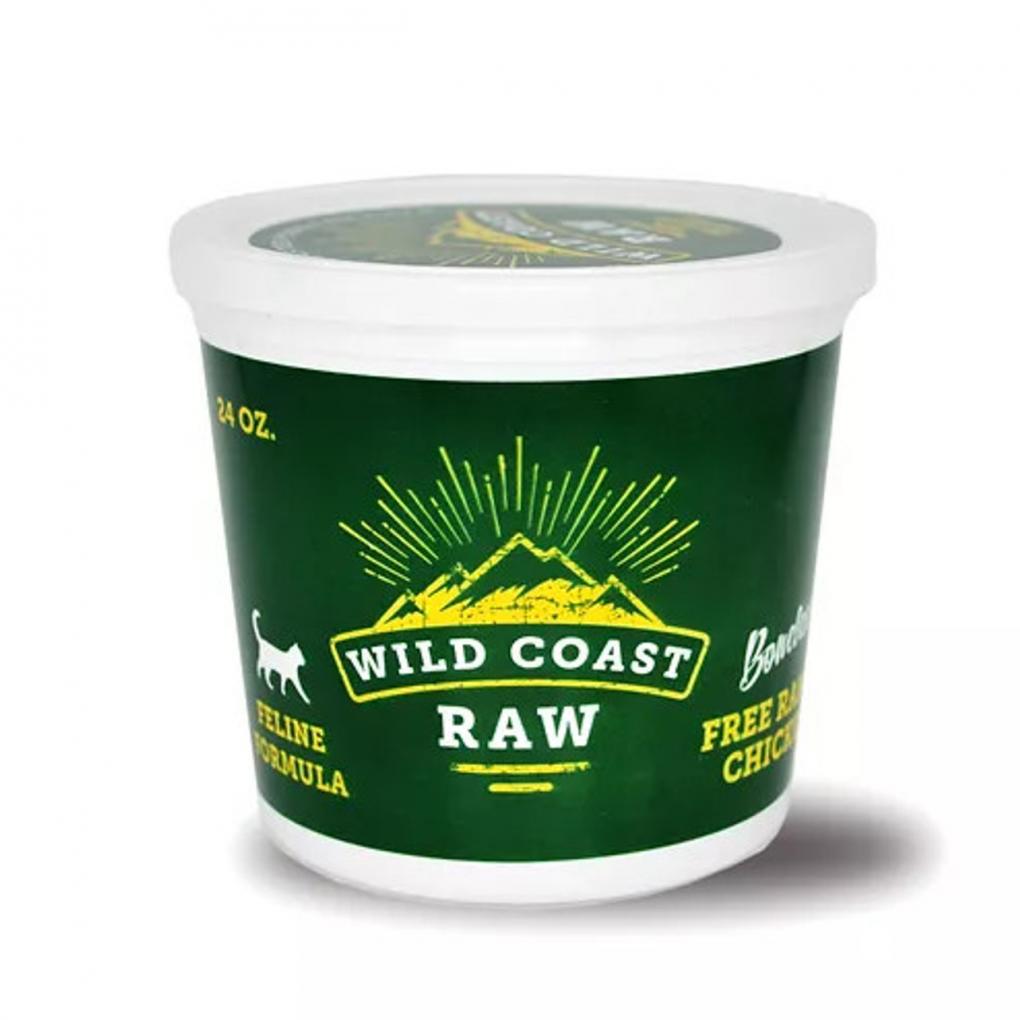
Wild Coast raw cat food recalled

March 2, 2025

Wild Coast LLC (dba Wild Coast Raw) has recalled six lot codes of raw cat food that may be linked to four cases of bird flu in domestic cats in Oregon and Washington states.

The recall encompasses 16oz and 24oz containers of the following lot codes of frozen Boneless Free Range Chicken Formula raw pet food for cats, all bearing a Best Buy date of 12/25:

  • #22660
  • #22653
  • #22641
  • #22639
  • #22672
  • #22664.

The recalled products were distributed only in Oregon and Washington states.

The recalled lots have to potential to be contaminated with Highly Pathogenic Avian Influenza (HPAI) H5N1 virus, also known as bird flu.

The public first was alerted to this problem in mid-February, when the Oregon Department of Agriculture (ODA) reported two cases of bird flu in domestic cats from two separate households.

Both cats had been fed the recalled product. The ODA found the same strain of H5N1 in the affected cats and in the Wild Coast Raw pet food they had eaten.

The Washington State Department of Agriculture (WSDA) opened an investigation of the company in response to the ODA findings and also put a “stop sale” order on lot codes #22660 and #22664. The “stop sale” order was valid only with in the borders of Washington state.

More recently, the WSDA learned of two domestic cats in Washington who also became infected with bird flu after being fed Wild Coast Raw pet food. The cats were members of two different households.

Three of the four infected cats in Washington and Oregon were euthanized due to the severity of their illnesses. The fourth cat is being treated by a veterinarian.

Yesterday’s recall notice expands the scope of the implicated products to include any raw material sharing similar production dates and lot codes to the two lot codes covered by the initial “stop sale” order.

Do not sell or donate the recalled products. Do not feed the recalled product to pets or any other animals. Consumers who have purchased this product are urged to immediately and securely discard to prevent animals and wildlife from consuming the recalled product. Contact your place of purchase for a full refund. For more information contact Wild Coast Raw at info@wildcoastraw.com or (360) 591-3543 between 8am – 4 pm PST.


“A complete and compelling account of the hidden and not-so-hidden ways the food we give our beloved pets can be contaminated.” JoNel Aleccia, Health Reporter, Food & Nutrition, The Associated Press.

“An invaluable resource for busy pet owners” – Food Safety News

Available from all major on-line retailers, including:

Two more domestic cats infected with bird flu

February 27, 2025

Two domestic cats in the state of Washington have been infected with the highly pathogenic avian influenza (HPAI) virus according to a new release from the Washington State Department of Agriculture (WSDA) dated February 26, 2025.

The infections were confirmed in testing conducted by the National Veterinary Services Laboratory.

One of the cats was euthanized and the second is being treated by a veterinarian.

The two cats belonged to separate households in King and Snohomish counties.

Both infected cats were fed potentially contaminated Wild Coast Raw pet food. Two batches of Wild Coast LLC – Boneless Free Range Chicken Formula are the subject of a “stop sale” order in the state of Washington.

These new illnesses are in addition to the two illnesses reported by the Oregon Department of Agriculture (ODA) earlier this month.

On February 14, 2025, the ODA advised pet owners that two cats residing in separate households in Multnomah County had become infected with HPAI. Both cats were fed Wild Coast raw pet food.

Both cats were euthanized due to the severity of their illnesses.

All four cats were exposed to one or both of the same two lot numbers of the raw pet food, according to a spokesperson for the WSDA.

The WSDA began investigating Wild Coast’s manufacturing facility and operations on February 7th, the day that the first Oregon cat was confirmed to have been infected with HPAI. That investigation is ongoing and is still open.

While the HPAI infections have been confirmed in all four cats, the WSDA is still awaiting confirmation of the “non-negative” (positive PCR result) for the presence of live virus particles in samples of the two implicated lots.

When eFoodAlert asked what measures Washington state has put in place to reduce the risk to consumers and pet owners, we were told the following:

WSDA has been a leader in the country by conducting surveillance sampling for HPAI on non-heat treated meat or dairy based animal food. All our routine surveillance samples have been negative, including some of Wild Coast Raw’s earlier lots. Also conducting messaging to our stakeholders and to the general public about the risks, including the HPAI in cats graphic (attached) and blog. Implementing FDA’s recent requirement for pet food manufacturers to reanalyze their food safety plans to consider HPAI a known or reasonably foreseeable hazard and to identify how they will be addressing that hazard. Working with applicable partners to continue further investigation that are outside of our jurisdiction.


“A complete and compelling account of the hidden and not-so-hidden ways the food we give our beloved pets can be contaminated.” JoNel Aleccia, Health Reporter, Food & Nutrition, The Associated Press.

“An invaluable resource for busy pet owners” – Food Safety News

Available from all major on-line retailers, including:

Twelfth death in long-term care Listeria outbreak

February 24, 2025

A twelfth person has died in the Listeria monocytogenes outbreak traced to Lyons ReadyCare and Sysco Imperial Frozen Supplemental Shakes supplied to hospitals and long-term care facilities, according to a report released today by the US Centers for Disease Control and Prevention (CDC)

The deaths occurred in California, Illinois, Indiana, Michigan, Minnesota, North Carolina, New York, Tennessee, Texas, and Washington.

Since 2018, 38 people have been confirmed infected with the outbreak strain. Most of the victims reported that they lived in long-term care facilities or had been hospitalized prior to becoming ill.

Outbreak illnesses have been reported in 21 states to date: Alabama (1), California (4), Colorado (1), Connecticut (2), Florida (2), Illinois (2), Indiana (3), Maryland (1), Michigan (2), Minnesota (1), Missouri (1), North Carolina (2), Nevada (1), New York (3), Ohio (1), Oklahoma (1), Pennsylvania (1), Tennessee (2), Texas (5), Washington (1), and West Virginia (1).

Outbreak victims ranged in age from 43 to 101 years, with a median age of 78.

The CDC investigated this outbreak on three prior occasions: in 2018, 2021, and 2023. Epidemiological investigations determined that that sick people were residents in long-term care facilities and nursing homes and the likely source was a food served in those types of institutions; however, there was not enough information to identify a specific food.

A new cluster of six new infections caused by the same outbreak strain was identified in October 2024. This time, the CDC was able to flag a product of interest.

A traceback investigation by the US Food and Drug Administration (FDA) identified Lyons ReadyCare and Sysco Imperial Frozen Supplemental Shakes manufactured by Prairie Farms Dairy, Inc. (“Prairie Farms”) from the Prairie Farms facility in Fort Wayne, Indiana as the probable source of the outbreak.

During an inspection of the manufacturing facility, the FDA collected environmental and product samples at the Fort Wayne location. Three of the environmental swabs collected from the processing area tested positive for Listeria monocytogenes, and Whole Genome Sequencing established that the strain recovered from these samples was closely related to the outbreak strain.

On February 22, 2025, Lyons Magnus LLC recalled multiple Best-by date codes of seventeen (17) 4 oz. Lyons ReadyCare and Sysco Imperial Frozen Supplemental Shakes.

Symptoms of a Listeria infection

Symptoms usually start within two weeks after eating food contaminated with Listeria but may start as early as the same day or as late as 10 weeks after. Mild symptoms may include a fever, muscle aches, nausea, tiredness, vomiting, and diarrhea. If the more severe form of listeriosis develops, symptoms may include headache, stiff neck, confusion, loss of balance, and convulsions.

General recommendations

  • Distributors and foodservice customers, including hospitals and long-term care facilities who purchased or received Lyons ReadyCare and Sysco Imperial Frozen Supplemental Shakes should not sell or serve these products. Carefully clean and sanitize any surfaces or containers that they touched and follow FDA’s safe handling and cleaning advice to reduce the risk of cross-contamination. Listeria can survive in refrigerated temperatures 
    and can easily spread to other foods and surfaces.
  • If you or your family member have symptoms of listeriosis you should contact your health care provider to report your symptoms and receive care.

Recommendations for at-risk groups

  • Listeria is most likely to sicken pregnant women and newborns, adults aged 65 or older, and people with weakened immune systems. Other people can be infected with Listeria, but they rarely become seriously ill.
  • Pregnant women typically experience only fever, fatigue, and muscle aches. However, Listeria  infection during pregnancy can lead to miscarriage, stillbirth, premature delivery, or life-threatening infection of the newborn.
  • Call your healthcare provider right away if you have symptoms of a Listeria infection.

“Reads like a true crime novel” – Food Safety News

Interested in learning more about food safety and the history of foodborne disease outbreaks and investigations?

Click on the link to listen to a short excerpt, then follow the buy links to add a digital, print or audio copy to your personal library.

Chapter 6. Birth of a Pathogen

TAINTED is available in digital format from all major on-line retailers. Press the button to go directly to your preferred digital bookstore.