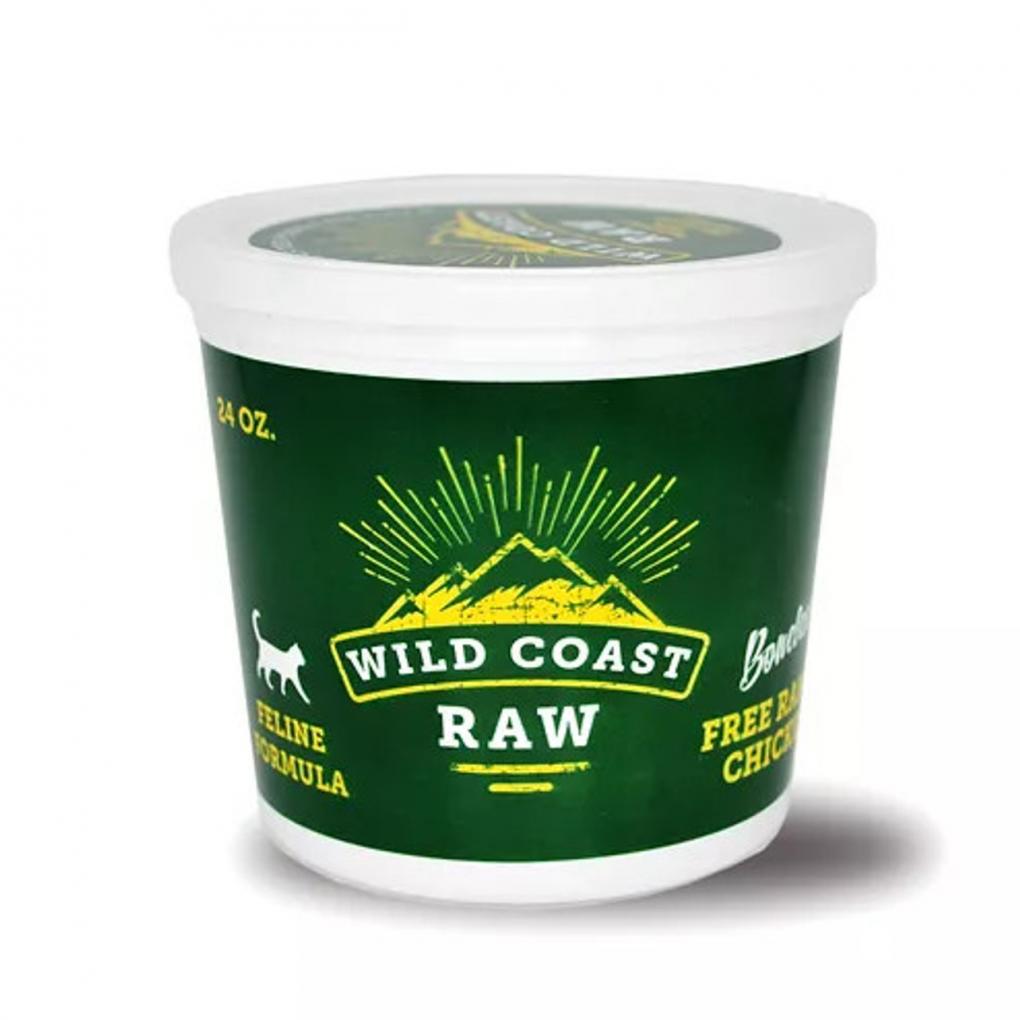
Wild Coast LLC (dba Wild Coast Raw) has recalled six lot codes of raw cat food that may be linked to four cases of bird flu in domestic cats in Oregon and Washington states.
The recall encompasses 16oz and 24oz containers of the following lot codes of frozen Boneless Free Range Chicken Formula raw pet food for cats, all bearing a Best Buy date of 12/25:
#22660
#22653
#22641
#22639
#22672
#22664.
The recalled products were distributed only in Oregon and Washington states.
The recalled lots have to potential to be contaminated with Highly Pathogenic Avian Influenza (HPAI) H5N1 virus, also known as bird flu.
The public first was alerted to this problem in mid-February, when the Oregon Department of Agriculture (ODA) reported two cases of bird flu in domestic cats from two separate households.
Both cats had been fed the recalled product. The ODA found the same strain of H5N1 in the affected cats and in the Wild Coast Raw pet food they had eaten.
The Washington State Department of Agriculture (WSDA) opened an investigation of the company in response to the ODA findings and also put a “stop sale” order on lot codes #22660 and #22664. The “stop sale” order was valid only with in the borders of Washington state.
More recently, the WSDA learned of two domestic cats in Washington who also became infected with bird flu after being fed Wild Coast Raw pet food. The cats were members of two different households.
Three of the four infected cats in Washington and Oregon were euthanized due to the severity of their illnesses. The fourth cat is being treated by a veterinarian.
Yesterday’s recall notice expands the scope of the implicated products to include any raw material sharing similar production dates and lot codes to the two lot codes covered by the initial “stop sale” order.
What consumers should know
Do not sell or donate the recalled products. Do not feed the recalled product to pets or any other animals. Consumers who have purchased this product are urged to immediately and securely discard to prevent animals and wildlife from consuming the recalled product. Contact your place of purchase for a full refund. For more information contact Wild Coast Raw at info@wildcoastraw.com or (360) 591-3543 between 8am – 4 pm PST.
“A complete and compelling account of the hidden and not-so-hidden ways the food we give our beloved pets can be contaminated.” – JoNel Aleccia, Health Reporter, Food & Nutrition, The Associated Press.
“An invaluable resource for busy pet owners” – Food Safety News
Available from all major on-line retailers, including:
Two domestic cats in the state of Washington have been infected with the highly pathogenic avian influenza (HPAI) virus according to a new release from the Washington State Department of Agriculture (WSDA) dated February 26, 2025.
The infections were confirmed in testing conducted by the National Veterinary Services Laboratory.
One of the cats was euthanized and the second is being treated by a veterinarian.
The two cats belonged to separate households in King and Snohomish counties.
Both infected cats were fed potentially contaminated Wild Coast Raw pet food. Two batches of Wild Coast LLC – Boneless Free Range Chicken Formula are the subject of a “stop sale” order in the state of Washington.
These new illnesses are in addition to the two illnesses reported by the Oregon Department of Agriculture (ODA) earlier this month.
On February 14, 2025, the ODA advised pet owners that two cats residing in separate households in Multnomah County had become infected with HPAI. Both cats were fed Wild Coast raw pet food.
Both cats were euthanized due to the severity of their illnesses.
All four cats were exposed to one or both of the same two lot numbers of the raw pet food, according to a spokesperson for the WSDA.
The WSDA began investigating Wild Coast’s manufacturing facility and operations on February 7th, the day that the first Oregon cat was confirmed to have been infected with HPAI. That investigation is ongoing and is still open.
While the HPAI infections have been confirmed in all four cats, the WSDA is still awaiting confirmation of the “non-negative” (positive PCR result) for the presence of live virus particles in samples of the two implicated lots.
When eFoodAlert asked what measures Washington state has put in place to reduce the risk to consumers and pet owners, we were told the following:
WSDA has been a leader in the country by conducting surveillance sampling for HPAI on non-heat treated meat or dairy based animal food. All our routine surveillance samples have been negative, including some of Wild Coast Raw’s earlier lots. Also conducting messaging to our stakeholders and to the general public about the risks, including the HPAI in cats graphic (attached) and blog. Implementing FDA’s recent requirement for pet food manufacturers to reanalyze their food safety plans to consider HPAI a known or reasonably foreseeable hazard and to identify how they will be addressing that hazard. Working with applicable partners to continue further investigation that are outside of our jurisdiction.
“A complete and compelling account of the hidden and not-so-hidden ways the food we give our beloved pets can be contaminated.” – JoNel Aleccia, Health Reporter, Food & Nutrition, The Associated Press.
“An invaluable resource for busy pet owners” – Food Safety News
Available from all major on-line retailers, including:
Highly pathogenic avian influenze (HPAI), more commonly known as bird flu, not only infects poultry flocks (backyard and commercial) and dairy herds.
The influenza A H5N1 virus (the current prevalent variety of bird flu virus in circulation) has been found in a range of wildlife species in addition to wild birds. From deer mice to dolphins, from cougars to coyotes, no mammalian species is completely immune from infection.
In recent weeks, it has become clear that household pets also are at risk.
Household pets that spend unsupervised time outdoors are at risk of coming into contact with infected wildlife, such as a sick or dead bird or rodent.
The risk is increased if the household also maintains a backyard poultry flock.
Caged birds may also be at risk, if they are allowed to fly free from time to time and come into contact with a wild bird.
Yet, even pets that are kept largely indoors and are under supervision while outside can become infected with the bird flu virus.
Bird flu and cats
Cats are more susceptible to bird flu infections than dogs. There have been several reports of barn cats and feral cats becoming as a result of exposure to H5N1 on dairy farms.
Domestic indoor cats also are at risk.
Recently, Food Safety News reported on a case involving three cats in one household that were fed raw milk from the California company, Raw Farm LLC in late 2024. Two of the cats died and a third became seriously ill. A fourth cat in the household, which did not drink any of the raw milk, remained healthy.
On December 3, 2024, Raw Farm LLC recalled all raw milk and cream products after the California Department of Food and Agriculture found multiple instances of H5N1 virus in the company’s raw milk.
The dairy’s owner, Mark McAfee, denied that his milk was the source of the virus that killed the cats, claiming that the H5N1 virus cannot survive for long periods in cold milk. However, a recent study funded by the National Institutes of Health determined that the H5N1 virus remained viable in refrigerated raw milk for five weeks with only a minor decline in virus levels.
The H5N1 virus can also be present in raw pet food.
On December 24, 2024, Northwest Naturals recalled one batch of Northwest Naturals brand 2lb Feline Turkey Recipe raw frozen pet food after it tested positive for highly pathogenic avian influenza (HPAI) virus. Testing was initiated after a cat that had been fed the raw pet food developed bird flu and died.
On December 31, 2024, the Los Angeles County Department of Health advised the public not to feed Monarch Raw Pet Food to their pets after the H5N1 virus was detected in a sample. Again, testing was initiated after a cat that had been fed the product became ill and was confirmed to be infected with the virus.
On January 3, 2025, Monarch Raw Pet Food Company issued a statement claiming that there was no scientific evidence to substantiate the link between their pet food and the cat illness.
What is the FDA doing to protect pet health?
eFoodAlert reached out to the FDA Center for Veterinary Medicine (CVM) and received the following statement from a CVM spokesperson:
The FDA is tracking cases of Highly Pathogenic Avian Influenza in domestic and wild cats in California, Colorado, Oregon and Washington State that appear to be linked to eating contaminated food products. No human illness has been reported from handling these foods or through contact between people and the animals.
Some of the animals were fed raw poultry or raw poultry pet food, while others ate unpasteurized milk. The FDA is working with state and federal counterparts to gather more specific information about what animals ate which foods and when, and to coordinate test results of the animals and the suspect foods.
The FDA and state authorities routinely work together to surveil the animal food supply, including pet food. This includes conducting risk-based facility inspections and collecting animal food samples to help ensure safety. The FDA may also collect samples “for cause,” such as when a pet food is suspected of being associated with human or animal illness. State authorities also regularly collect samples from retail settings and share test results with the agency. HPAI is an emerging contaminant in animal food. Analytical capacity is limited and pathogens like H5N1 can be difficult to detect because they might not be evenly distributed throughout the product (increasing the possibility of a false negative result).
Part of a pet food manufacturer’s responsibility is to bring a safe, wholesome product to market that is not adulterated under the Federal Food, Drug, and Cosmetic Act. As we learn more about the transmission of H5N1 in animal food, there are several practices that the FDA is encouraging pet food manufacturers and others in the supply chain to use to prevent HPAI transmission through animal food. These practices could include seeking poultry from flocks that are documented as having remained healthy throughout processing, and taking processing steps, such as heat treatment, that are capable of inactivating viruses and other hazards.
All recent detections of H5N1 in cats had these things in common: the infected cats ate wild birds, unpasteurized milk, raw poultry, and/or raw poultry pet food. We know that cats are particularly sensitive to HPAI, and that very young, very old or immune-compromised animals are at greater risk of infection. The FDA continues to recommend that consumers avoid feeding pets any products that are recalled or from affected farms if those products have not been thoroughly cooked or pasteurized to inactivate the virus. If consumers are unsure of the origin of those products, it’s safest to follow the USDA guidelines for handling and thorough cooking before feeding. Animals should also be kept from hunting and eating wild birds.
What to watch for
Symptoms of a bird flu infection vary with the species. Here is a short list of what to watch for. Contact your veterinarian if you suspect one of your pets may be infected with bird flu. If you or a household member begins to exhibit symptoms associated with the bird flu virus, contact your healthcare provider.
In backyard flocks or pet birds
Sudden death with no prior signs
Low energy or appetite
Purple discoloration or swelling of various body parts
Reduced egg production, or soft-shelled/misshapen eggs
Nasal discharge, coughing, or sneezing
Lack of coordination
Diarrhea
In cats and dogs
Fever
Lethargy
Low appetite
Reddened or inflamed eyes
Discharge from the eyes and nose
Difficulty breathing
Neurologic signs, like tremors, seizures, incoordination, or blindness



 eFoodAlert