
Germany’s Devastating E. coli Outbreak

The official numbers reported this morning by Germany’s Robert Koch Institut are worthy of a Hollywood thriller. Nine people dead, and 470 notified cases of hemolytic uremic syndrome (HUS) – a life-threatening complication of enterohemorrhagic E. coli infections.

The German outbreak data reported by BBC and others are even worse. Sixteen deaths, including one in Sweden; 1,534 infected with the outbreak strain known as E. coli O104:H4 – 470 of them suffering from HUS.

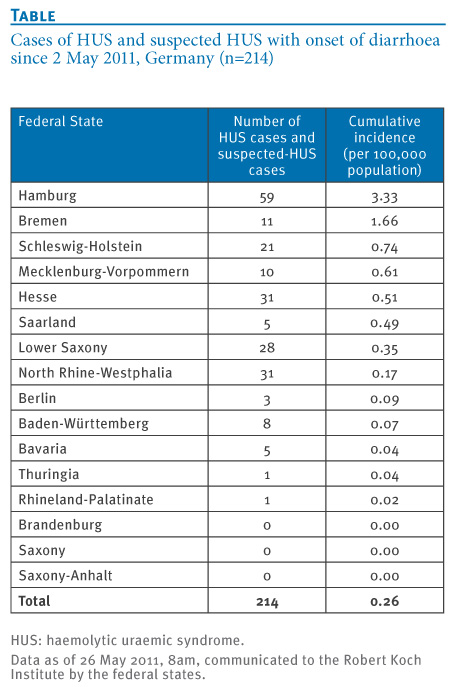
The outbreak began in Northern Germany; the heaviest concentration of confirmed cases – and of HUS – can be found in the states of Hamburg and Bremen. As of May 26th, thirteen German states had reported 214 cases of HUS – Hamburg (59), Bremen (11), Schleswig-Holstein (21), Mecklenburg-Vorpommern (10), Hesse (31), Saarland (5), Lower Saxony (28), North Rhine-Westphalia (31), Berlin (3), Baden-Württemberg (8), Bavaria (5), Thuringia (1) and Rhineland-Palatinate (1). These numbers already are far out of date, as the total number of cases has more than doubled since that report was issued.

Thanks to the ease of international travel – especially within the European Union, where most borders are invisible and undefended – the outbreak has not been confined to Germany. Eight other countries have reported confirmed or suspect cases of enterohemorrhagic E. coli in German nationals visiting their country or in individuals who reported having traveled to Germany:

  • Austria: 2 cases
  • Denmark: 14 cases, 6 with HUS
  • France: 6 cases
  • Netherlands: 7 cases, 3 with HUS
  • Spain: 1 case
  • Sweden: 41 cases, 15 with HUS and one death
  • Switzerland: 2 cases 
  • United Kingdom: 3 cases, 2 with HUS

Despite the best efforts of Germany’s epidemiologists, the source of this outbreak is unknown – except that it appears to be associated with consumption of raw tomatoes, cucumber and leaf salad.

For a time, suspicion fell on raw cucumbers imported from Spain – especially after lab analysis of two cucumber samples yielded enterohemorrhagic E. coli. But the cucumber contaminant did not match the outbreak strain.

The most frightening aspect of this outbreak, other than the lack of success in finding its cause, is the unusually high percentage of victims who have developed HUS – more than 30% of victims, as compared to the 5-10% HUS rate experienced in most other outbreaks.

HUS is a life-threatening complication, usually beginning with kidney failure and often progressing to failure of other organs and systems. Some 5-10% of HUS patients die, and most others suffer life-long consequences of their fight for survival – even with treatment. Conventional treatment consists of dialysis and, where necessary, plasma exchange.

The massive and deadly Canadian E. coli O157:H7 outbreak that was centered in Walkerton, Ontario in 2000 spurred Canadian researchers to study ways of preventing HUS – by preventing the bacterial toxins from binding to its target cells in the body. Researchers at the University of Maryland and in Argentina independently explored similar approaches – using monoclonal antibodies against the toxin in order to block its activity.

Just a few days ago, researchers in Canada, France and Germany reported that they used yet another antibody to treat successfully three 3-year-old children who were suffering from severe cases of HUS. But this new development might be too late to help many of the German outbreak victims.

The German outbreak has many unknowns:

  • What is the source?
  • What is the true number of illnesses?
  • Why is the incidence of HUS so high?
  • Why have adult women been disproportionately stricken?

And, most importantly, when will it end?

Recalls and Alerts: May 31, 2011

Here is today’s list of food safety recalls, product withdrawals, allergy alerts and miscellaneous compliance issues. The live links will take you directly to the official recall notices and company news releases that contain detailed information for each recall and alert.

If you would like to receive automatic email alerts for all new articles posted on eFoodAlert, please submit your request using the sidebar link.

United States

  • Food Safety Recall: Irish Hills Meat Company of Michigan (Tipton, MI) recalls 900 pounds of ground beef products that may be contaminated with E. coli O157:H7. The recalled  ground beef was produced on May 23 and May 26, and shipped to restaurants in Michigan.
  • Food Safety Recall: Stewart’s Shops (Saratoga Springs, NY) recalls 19 ice cream items manufactured in their Greenfield, NY facility since May 19, 2011, due to an equipment failure that may have resulted in the introduction of foreign material into the ice cream. The recalled products – packed in cartons or boxes bearing Plant #36-3918 -were distributed to Stewart’s Shops in New York and southern Vermont.
  • FDA Warning Letter: FDA warns Reed’s Inc. (Los Angeles, CA) that an October/November inspection of the company’s carbonated beverage and human dietary supplement manufacturing facility revealed significant violations of the Current Good Manufacturing Practice (cGMP) in Manufacturing, Packaging, Labeling, or Holding Operations for Dietary Supplements regulations, causing the Reed’s Nausea Relief dietary supplement products manufactured in your facility to be adulterated, in that the dietary supplements have been prepared, packed, or held under conditions that do not meet current good manufacturing practice regulations for dietary supplements.
  • FDA Warning Letter: FDA warns Family Fresh Pack, LLC (Belleville, WI) that a December 2010/January 2011 inspection of the company’s seafood processing facility revealed serious violations of the seafood Hazard Analysis and Critical Control Point (HACCP) regulation, and the Current Good Manufacturing Practice (cGMP) regulation for foods.
  • FDA Warning Letter: FDA warns Natural Choice Distribution Company (Oakland, CA) that a February 2011 inspection of the company’s seafood processing facility revealed serious violations of the seafood Hazard Analysis and Critical Control Point (HACCP) regulation, and the Current Good Manufacturing Practice (cGMP) regulation for foods.
  • FDA Warning Letter: FDA warns Manolo and Son, LLC (Alexandria, VA) that a March 2011 inspection of the company’s seafood processing facility revealed serious violations of the seafood Hazard Analysis and Critical Control Point (HACCP) regulation.
  • FDA Warning Letter: FDA warns Contes Pasta Company, Inc. (Vineland, NJ) that a January/February 2011 inspection of the company’s seafood processing facility revealed serious violations of the seafood Hazard Analysis and Critical Control Point (HACCP) regulation, and the Current Good Manufacturing Practice (cGMP) regulation for foods.
  • FDA Warning Letter: FDA warns Nuvonyx, Inc. DBA Real Aloe, Inc. and U.S. Aloe (Carlsbad, CA) that October 2010 and  January 2011 inspections of the company’s facility revealed significant violations of Current Good Manufacturing Practice in Manufacturing, Packaging, Labeling or Holding Operations for Dietary Supplements (CGMP) regulations.
  • FDA Warning Letter: FDA warns Import Food Wholesale (St. Paul, MN) that a November 2010 inspection of the company’s seafood processing facility revealed serious violations of the seafood Hazard Analysis and Critical Control Point (HACCP) regulation, and the Current Good Manufacturing Practice (cGMP) regulation for foods.
  • FDA Warning Letter: FDA warns Country Maid, Inc. (Milwaukee, WI) that a December 2010 inspection of the company’s food processing facility revealed serious violations of the seafood Hazard Analysis and Critical Control Point (HACCP) regulation, and the Current Good Manufacturing Practice (cGMP) regulation for foods.
  • FDA Warning Letter: FDA warns Dawn’s Foods, Inc. (Portage, WI) that a February 2011 inspection of the company’s seafood processing facility revealed serious violations of the seafood Hazard Analysis and Critical Control Point (HACCP) regulation, and the Current Good Manufacturing Practice (cGMP) regulation for foods.
  • FDA Warning Letter: FDA warns ADAO, Inc. (Denver, CO) that a December 2010 inspection of the company’s food manufacturing facility revealed serious violations of the Current Good Manufacturing Practice (CGMP) regulations in manufacturing, packing, or holding of human food, causing the products manufactured in the Denver facility to be adulterated, in that they were prepared, packed, or held under insanitary conditions whereby they may have been contaminated with filth, or whereby they may have been rendered injurious to health.
  • FDA Warning Letter: FDA warns Tiny Greens (Urbana, IL) that a December 2010-January 2011 inspection of the company’s sprouting facility revealed conditions and practices that are likely to have contaminated the products, causing the sprouts to be adulterated, in that they were packed, or held under insanitary conditions whereby they may have been contaminated with filth or rendered injurious to health. Sprouts produced by Tiny Greens were responsible for an outbreak of Salmonella gastroenteritis that sickened 140 people in 26 states and the District of Columbia between November 2010 and February 2011.
  • FDA Warning Letter: FDA warns Valley Wholesale Produce and Seafood (Winchester, VA) that a March 2011 inspection of the company’s produce and seafood warehouse revealed serious violations of the seafood HACCP regulation.
  • FDA Warning Letter: FDA warns Great Oriental Food Products Co., Ltd. (Mae Sod, Thailand) that a January 2011 inspection of the company’s low-acid canned food facility revealed serious deviations from the low-acid canned food regulations.
  • FDA Warning Letter: FDA warns Guangxi Jisheng Foods Inc. (Hengxian, China) that a January 2011 inspection of the company’s low-acid canned food facility revealed serious deviations from the low-acid canned food regulations.
  • FDA Warning Letter: FDA warns Franklin Foods, Inc. (Delray Beach, FL) that a September/October inspection of the company’s food processing facility located in Enosburg Falls, Vermont revealed serious violations of the seafood HACCP regulation, regarding the manufacturing of smoked salmon cream cheese.

Canada

Europe

  • Food Safety Recall (Norway): Kjøttvirksomheten Kuraas AS (Narvik) has withdrawn a number of meat products after Salmonella was detected in a sample of pork. Please see the official withdrawal notice for distribution details on the seven tons products of withdrawn pork and beef products.
  • Food Safety Notification (EU #2011.0710): Mercury in frozen red snapper fillets from Madagascar; distributed to France.
  • Food Safety Notification (EU #2011.0711): Dioxins and dioxin-like polychlorobiphenyls in frozen cooked crabs from Ireland; distributed to France.
  • Outbreak Alert (Russia): Twenty-six children, aged 10 to 13 years, have been hospitalized, and an additional 45 people isolated after the attendees at Sail camp (near Novgorod) were stricken by what is believed to be food poisoning.

Asia, Africa and the Pacific Islands

Australia and New Zealand

  • Food Safety Alert (New Zealand): The Ministry of Agriculture and Food has opened an investigation into Kaiora New Zealand International, a company that is allegedly selling and exporting Heitiki infant formula. The investigation will focus on food safety concerns, as well as possible breaches of requirements such as labeling, advertising, and claims.
  • Shellfish Safety Advisory (New Zealand): Upper Whangarei Harbour has been closed for gathering shellfish until July 2nd, after high levels of norovirus were found in Whangarei wastewater and the upper harbour during a May 2nd storm.

Some supermarket chains post recall notices on their web sites for the convenience of customers. To see whether a recalled food was carried by your favorite supermarket, follow the live link to the supermarket’s recall web site.

Recalls and Alerts: May 30, 2011

Here is today’s list of food safety recalls, product withdrawals, allergy alerts and miscellaneous compliance issues. The live links will take you directly to the official recall notices and company news releases that contain detailed information for each recall and alert.

If you would like to receive automatic email alerts for all new articles posted on eFoodAlert, please submit your request using the sidebar link.

United States

  • Pet Food Safety Recall: Primal Pet Foods recalls Feline Chicken & Salmon Formula (4-lb; Best by 043112-17), because the product may be contaminated with Salmonella. The product was distributed through retail stores throughout the USA.

Canada

  • Food Safety Alert: CFIA is warning the public that the cancer-causing chemical DEHP (Di-Ethyl Hexyl Phthalate) is being added to certain foods and beverages imported from Taiwan. CFIA and Health Canada are working with importers and international health agencies to identify affected products.

Europe

Asia, Africa and the Pacific Islands

  • Food Safety Recall/Alert (Singapore): Agri-Food & Veterinary Authority of Singapore (AVA) suspends the import of Sunlight Brand beverages (product of Taiwan) after detecting DEHP in a sample of Sunlight Brand Star Fruit Juice. AVA has instructed the importer to remove the product from the market. Consumers who may have purchased the product are advised to discard it.
  • Pharmaceutical Product Safety Recall (Hong Kong): Cerebos (Hong Kong) Ltd recalls Brand’s Calcium Grow Chewable Tablets (product of Taiwan), because the strawberry juice powder and yogurt powder used as flavoring agents have been reported to be contaminated by DEHP.

Australia and New Zealand

  • Food Safety Recall (New Zealand): Sara Lee recalls Sara Lee Gourmet Beef Lasagne and Sara Lee Gourmet Vegetable Lasagne, due to possible contamination with foreign material, including metal, plastic and cloth. The recalled products were sold in all major supermarkets nationwide, including Countdown, Woolworths, Foodtown, New World, Pak’n Save, Fresh Choice, and SuperValue, and were supplied to food service operators.

Some supermarket chains post recall notices on their web sites for the convenience of customers. To see whether a recalled food was carried by your favorite supermarket, follow the live link to the supermarket’s recall web site.