

Diamond Pet Foods Recalls: International Buyers Be Wary! – UPDATED

“We do not share our product and distribution lists for competitive reasons.”

– Diamond Pet Foods (by email), June 8, 2012

More than two months after its initial recall announcement, and more than one month after announcing its expanded recall of dry pet food manufactured in Gaston, South Carolina, Diamond Pet Foods still has not provided international consumers with a list of countries (other than the USA and Canada) that are affected by its product recalls.

Nor, eFoodAlert has been told, does the company intend to do so in future. In reply to my repeated email and telephone requests for a list of countries to which the recalled products had been shipped, Diamond’s Media Desk put up a stone wall.

It’s not as though I was asking for a list of the company’s overseas wholesale and distribution network; all I was looking for was a list of countries.

FDA, too, has declined to release a list of affected countries, citing “confidentiality” concerns. It is standard practice, though, for FDA to notify all appropriate foreign counterparts in the event of any Class 1 recall, according to Laura Alvey, Deputy Director, Communications Staff for FDA’s Center for Veterinary Medicine. It’s then up to the notified counterpart agencies to decide what to do with the information.

This latest round of futile effort at communicating with Diamond Pet Foods was triggered by a pet owner in Malaysia who communicated with Mollie Morrissette of Poisoned Pets. This consumer purchased a bag of Taste of the Wild dog food with an unusual label.
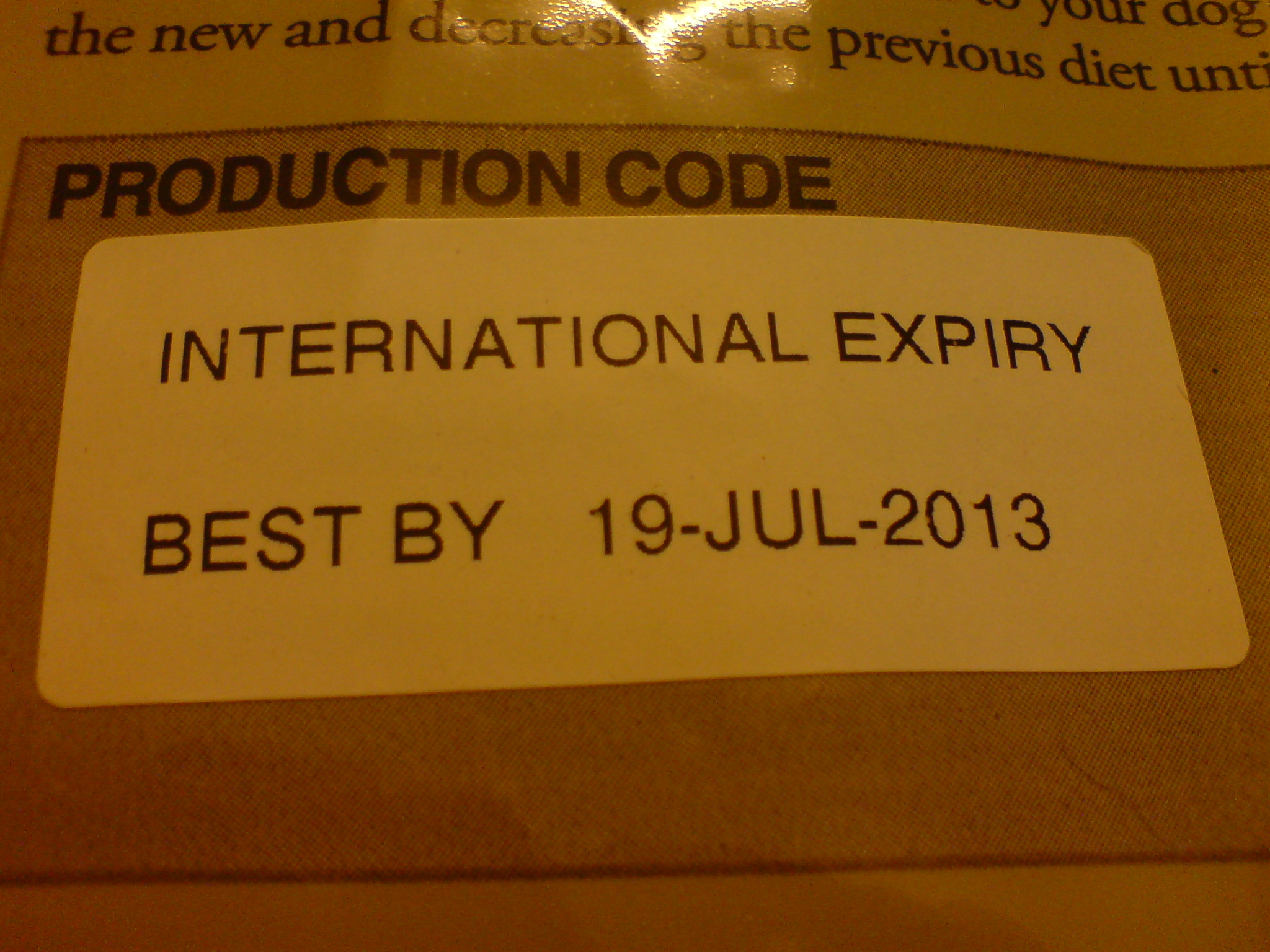
Stick-on label on bag of Taste of the Wild dog food

When he peeled the label off of the bag, he discovered that the dry dog food he purchased from his local supplier was actually included in the list of recalled production codes and bore a Best before date of 19/Jan/2013.
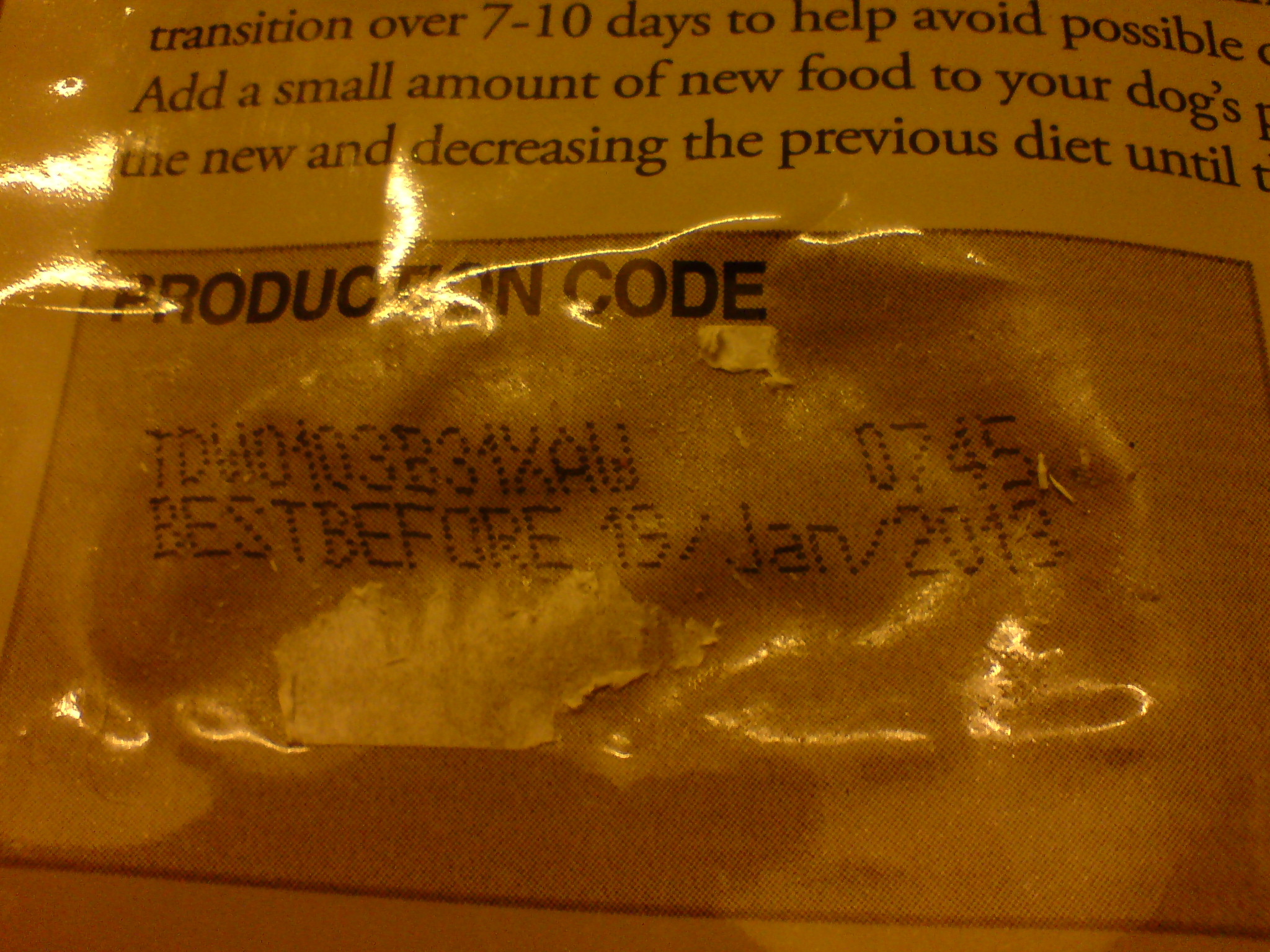
Production code and expiry date revealed after stick-on label was removed

I was able to determine that this stick-on label was NOT affixed by Diamond Pet Foods. “Diamond Pet Foods,” I was told in an email, “does not use a sticker for production codes or date codes. Our production and date codes are printed on the packaging inline after the bag is filled and sealed. Countries may use different date formats depending on the regulation of the importing country.” The company’s reply did not address the alteration in the Expiry date.

UPDATE (June 11, 2012): The pet owner in Malaysia received the following reply from Diamond Pet Foods earlier today:

The distributor made a mistake and did not inform us until your complaint.

They sticker another pet food competitor’s bags and their warehouse over stickered ours by mistake.

They are not authorized to do this and i have informed them of the damage that has been done in particular through comments made in pet food alert.

Disappointed this happened and too bad we did not have an opportunity to investigate and rectify.

Will not be happening again.

Adding to the confusion and consternation are the reports from European consumers. A consumer in Ireland and one in Holland were told by their retailer (Zooplus) that the recalled bags of Taste of the Wild dog food had been retested on entry to the EU, had been found to be safe, and that the recall codes could be disregarded. The original production codes and expiration dates imprinted on the bags by the manufacture were not altered or hidden in Europe.

Pet owners in Australia and Singapore, on the other hand, can breathe more easily than their European and Malaysian counterparts. Formal recall notices for the affected batches of food have been issued by the Singapore distributors, and are posted on the web site of the Agri-food and Veterinary Authority of Singapore. And the recalled product never was shipped to Australia. I have been informed by a spokesperson at Australia’s Department of Agriculture, Fisheries and Forestry that “…manufacturing facilities that produce goods for Australia are all located in California.” Diamond’s California manufacturing plant was not implicated at all in the company’s pet food recalls.

As of last report, the contaminated pet food was the source of 15 cases of Salmonella Infantis infections in the USA and 2 cases in Canada. At least two dogs are confirmed to be infected with the outbreak strain, and dozens of other reports of sick animals – dogs and cats – have been posted by readers of eFoodAlert. The full animal and human scope of this outbreak is undoubtedly far larger than the reported numbers of cases.

More worrisome than the actual numbers, however, is the inadequacy of the notification system. It’s usual for FDA to include in its Weekly Enforcement Reports (one of which will almost certainly summarize the Diamond Pet Food recalls – eventually) a list of countries to which a recalled product was shipped. But by then, the information will be irrelevant. Why not release this information when it can be of some use?

And why is Diamond Pet Foods making such a secret of which countries were the recipients of the recalled products?

Fourth Louisiana Case in E. coli O145 Outbreak

Louisiana has just confirmed a fourth case of E. coli O145 in a six-state outbreak whose source has not yet been identified.

All four Louisiana victims became ill during late April and early May 2012. A 21-month old child died as a result of her illness. The other three victims are adults living in the Greater New Orleans area, according to a report just released by the Louisiana Department of Health & Hospitals.

Associated Press reports that the outbreak now includes 14 victims in six states: Georgia (5), Louisiana (4), Alabama (2), Tennessee (1), Florida (1) and California (1). Three people were hospitalized.

There is, as yet, no indication of the source of the outbreak. Dr. Raoult Ratard, Louisiana’s State Epidemiologist told me that the little girl who died had visited a petting zoo, but that the other Louisiana victims had not. Investigators from the state visited the zoo, and determined that it follows all guidelines to safeguard its patrons from infection.

Outbreak victims in Louisiana – and, presumably, the other affected states – are now being interviewed with a standard questionnaire to try to identify a common element to this rash of illnesses.

CDC has been mumchance. In response to my email inquiry, I was told by CDC spokesperson Lola Russell that the federal agency is “not in the lead in this outbreak.” She advised me to “reach out” to the various states, but declined to name them. Nor did she indicate which state was coordinating the outbreak investigation.

This could turn out to be one of those frustrating outbreaks for which a source is never identified. The victims are widely scattered; even the five cases in Georgia are spread over four counties. Louisiana might be the best bet in the search for a common element, since that state’s three adult outbreak victims are all from the Greater New Orleans area.

Regardless of whether or not a source is identified, this outbreak is a reminder to all consumers and food handlers to intensify their food safety awareness in advance of the summer holiday season.

Who Cares Which E. coli Makes Someone Ill?

There’s been some hoopla in the food news this week. Six more E. coli serotypes (in addition to E. coli O157:H7) are now to be treated as adulterants by USDA when they are found in raw beef trim.

The addition of these toxin-producing E. coli serotypes to the pantheon of named adulterants is largely due to the efforts of Bill Marler. And I applaud his desire to advance food safety.

But what happens when an eighth serotype causes an illness outbreak? For example, E. coli O104:H4 the serotype that caused last summer’s massive outbreak in Germany, is not one of the “super six” newly named adulterants.

I was reminded of this problem yesterday while speaking with Dr. Raoult Ratard, State Epidemiologist with the Louisiana Department of Health and Hospitals. We were discussing the illness outbreak in several southern US states, and the shiga-toxin-producing E. coli O145 strain that was recovered from patients. As of today, there are 12 confirmed illnesses in Georgia (5), Louisiana (3, including a 21-month-old girl who did not survive), Alabama (2), Florida (1) and Tennessee (1).

I asked Dr. Ratard whether he could confirm that the Louisiana illnesses were due to E. coli O145. With a verbal shrug, he replied that he did not know; Louisiana does not do an immunological identification of E. coli strains, beyond determining whether or not they are E. coli O157:H7. He opined that this would be a waste of time and resources, given the number of different strains in circulation.

Instead, Louisiana looks for shiga-toxin producting E. coli, determines whether or not the strain is E. coli O157:H7, and runs a genetic profile (known as PFGE). The PFGE result is emailed to the CDC, and the culture is purified and shipped to the agency labs. As far as Louisiana is concerned, the exact identification of the E. coli serotype is interesting from an academic perspective, but not something that they care to spend time on.

After thinking about this for a couple of minutes, I found myself agreeing with Dr. Ratard. There was a time when determining the serotype was a useful tool in tracing the source of a disease outbreak. That tool has been supplanted by a much more precise and reliable tool, in the form of genetic profiling.

Which brings me back to USDA and the “super six serotypes” that are in the media spotlight. What the agency should have done – and what I proposed back in 2009 – was to simply declare ANY shiga-toxin producing E. coli as an adulterant.

  • The toxin doesn’t care which serotype is producing it.
  • The patients don’t care which serotype is making them ill.
  • The epidemiologists no longer rely on serotyping to define an outbreak.

So why should USDA set up seven individual small targets (E. coli O157:H7 and the “super six”) instead of a single inclusive target known around the world as “shiga-toxin producing E. coli?

Beats me!