

This story by Marion Nestle first appeared on Food Politics and is reposted here with the author’s permission.
AAFCO, the American Association of Feed Control Officials, says its membership has at last agreed to fix pet food labels so they look more like Nutrition Facts labels. When this happens, you might possibly be able to understand them.
Here’s what the nutrition information on a pet food label looks like now.
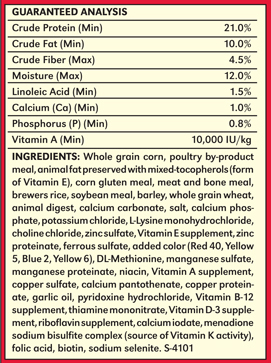
Pet food labels follow the regulations for animal feed, not human food.
This might have made sense when dogs and cats were on their own to hunt or be fed household scraps, but it makes no sense at all now that pets are considered members of the family—fur babies.
The agreed-upon changes have to be incorporated into state regulations, and manufacturers need time to adopt them. Everybody gets 6 years to do this, although some companies will undoubtedly start using the new rules right away.
The changes will be in four areas of the labels:
- Nutrition Facts Box – Updated to resemble human-food labeling more closely. This will be a Pet Nutriton Facts panel.
- Intended Use Statement – Updated to new location on the lower-third of the front display panel to help consumers easily identify the purpose of the pet food.
- Ingredient Statement – Updated to clarify the use of consistent terminology and allow parentheticals and common or usual names for vitamins.
- Handling and Storage Instructions (optional) – Updated and standardized with optional icons for greater consistency.
This is a great step forward. One reason why I think so is that the new Pet Nutrition Facts label is exactly what Mal Nesheim and I recommended in our book, Feed Your Pet Right.
That book came out in 2010; these rules go into effect in 2029.
It pays to be patient—and to persist!
Marion Nestle is Paulette Goddard Professor, of Nutrition, Food Studies, and Public Health, Emerita, at New York University, which she chaired from 1988-2003 and from which she officially retired in September 2017. She is also Visiting Professor of Nutritional Sciences at Cornell. She earned a Ph.D. in molecular biology and an M.P.H. in public health nutrition from the University of California, Berkeley, and has been awarded honorary degrees from Transylvania University in Kentucky (2012) and from the City University of New York’s Macaulay Honors College (2016).


 eFoodAlert