
The Council of State and Territorial Epidemiologists (CSTE) has approved a position statement recommending that invasive Cronobacter infection in infants be added to the list of approximately 120 notifiable diseases in the United States.
The position statement was developed by the CSTE in conjunction with the US Centers for Disease Control and Prevention (CDC), the Food and Drug Administration (FDA) and the Association of Public Health Laboratories (APHL).
The CSTE is a voting body comprised of State Epidemiologists from all U.S. states, territories, and the District of Columbia.
The text of the statement will be released in coming weeks.
STOP Foodborne Illness, a national public health non-profit organization, hailed the announcement, predicting that the CSTE decision would have a “…meaningful impact on infant mortality.”
A look back
In February 2022, consumers were shocked to learn of four infant illnesses due to Cronobacter infections linked to consumption of powdered infant formula manufactured by Abbott Nutrition.
As the months passed and more was learned about the evolution of the contamination problem, food safety experts and members of the public began to advocate for adding Cronobacter to the list of infectious diseases reported as a matter of course to the CDC’s national surveillance database.
Notifiable versus reportable
What is a notifiable disease, and how does it differ from a reportable disease?
Although these two terms are often used interchangeably in the context of disease surveillance, they actually have quite different meanings as far as the CDC is concerned.
This screenshot from the CDC website explains the differences between notifiable and reportable diseases.
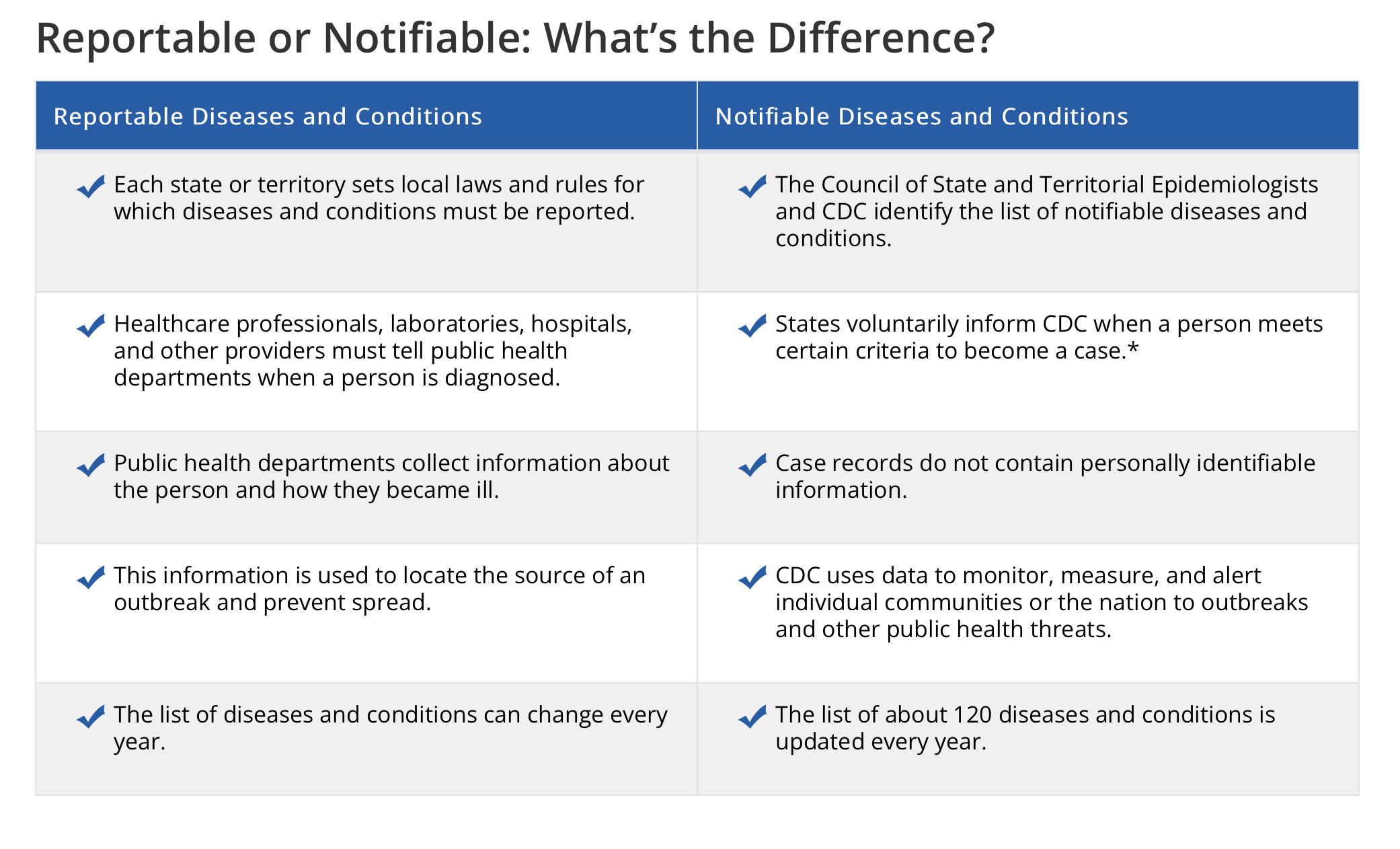
Reporting of notifiable disases is voluntary, and personal information is redacted from the reports that reach the CDC. The data from notifiable disease reports is useful for statistical surveillance, but cannot easily be used to locate the source of an outbreak.
On the other hand, reportable diseases (which are specified individually by each state or territory) MUST be reported to public health authorities by healthcare professionals, hospitals and laboratories. Reports supplied to the CDC in these instances contain information on the individual patients, and can be used to track the source and scope of disease outbreaks.
A notifiable disease may also be reportable by one or more states and territories, if those local authorities decide to make it so.
Under no circumstances does the CDC have the authority to MANDATE reporting of either notifiable or reportable diseases.
The bottom line
Adding invasive Cronobacter infection in infants to the list of national notifiable diseases is a long overdue action, which will improve the CDC’s ability to track trends in the frequency of this disease condition.
Let us hope that it will also spur additional states and territories to mandate reporting of Cronobacter infections to local public health authorities in their jurisdictions.

Interested in learning more about food safety and the history of foodborne disease outbreaks and investigations?
Click on the link to listen to a short excerpt, then follow the buy links to add a digital, print or audio copy to your personal library.
TAINTED is available in digital format from all major on-line retailers. Press the button to go directly to your preferred digital bookstore.


 eFoodAlert