Salmonella Outbreak Exposes Flaw in FDA ‘Import Alert’ System

The Food and Drug Administration (FDA), the Centers for Disease Control and Prevention (CDC), the Maryland Department of Health (MDH) and other state and local agencies continue to investigate the  outbreak of Salmonella Kiambu illnesses, which has sickened 47 people and has already claimed one life.

The CDC posted this photo with the outbreak notice, describing maradol papayas as large, oval fruits that weigh 3 or more pounds, with green skins that turn yellow when the fruit is ripe. The flesh inside the fruit is salmon-colored.” Photo courtesy of CDC

Based on sampling and analysis reported by MDH, the outbreak appears to be linked to consumption of Maradol papayas, imported from Mexico. On July 26, 2017, Grande Produce (San Juan, TX) recalled Caribeña brand Maradol papayas that were shipped to an unnamed Maryland distributor center between July 10 and July 19.

The introduction of Salmonella-contaminated papayas into the US retail market occurred despite the issuance in August 2011 of Import Alert 21-17, COUNTRYWIDE DETENTION WITHOUT PHYSICAL EXAMINATION OF PAPAYA FROM MEXICO.

What is an Import Alert?

An Import Alert informs “…FDA field staff and the public that the agency has enough evidence to allow for Detention Without Physical Examination (DWPE) of products that appear to be in violation of FDA laws and regulations.” It can be very narrow (apply to a single company or importer) or extremely broad, as in the case of Import Alert 21-17. The purpose of the Import Alert is to place the burden of proving product safety on the shoulders of the producer or importer. The first Import Alert was issued in 1974.

History of Import Alert 21-17

Mexican papayas were the source of a Salmonella Agona outbreak that sickened 106 people in 25 US states between January 1 and August 25, 2011. The outbreak was traced to several brands of papayas distributed in the USA and Canada by Agromod Produce, Inc.

During the investigation into the source of the outbreak, FDA analyzed 211 samples of Mexican papayas, finding Salmonella in 33 (15.6 percent) of them. The positive samples came from 28 different firms and nearly all the major papaya-growing regions of Mexico. In response to the extent of the contamination, FDA issued Import Alert 21-17 on August 25, 2011.

Are there any exceptions to the Import Alert?

FDA policy allows for exemptions to an Import Alert, if a company can provide evidence that their products are likely to remain in compliance with FDA laws and regulations. In the case of Import Alert 21-17, FDA considers Salmonella-negative test results from five consecutive shipments over a period of time to be evidence of probable compliance. Entities able to meet these criteria may apply for an exemption. If accepted, they are added to  the Green List appended to the Import Alert.

How does the Green List Work?

At last count, FDA has granted 98 exemptions in the nearly six years during which the Import Alert has been in force. Once granted, exemptions remain in effect unless FDA receives evidence of lack of compliance, such as a result of a consumer complaint, a Salmonella-positive routine retail surveillance sample. There is no requirement for inspection of the exempt entity’s operations, for routine or periodic submission of lab test results, or for any other form or recertification. A Green-listed entity under Import Alert 21-17 has carte-blanche to ship papayas from Mexico into the USA.

What Happens to Detained Shipments under Import Alert 21-17?

Entities whose products are detained without physical examination may apply to have those products released by submitting evidence from a third-party laboratory that the product is not contaminated with Salmonella. Otherwise, the product either will be refused entry into the USA, or will be destroyed.

The action taken last week by Grande Produce represents the second time in recent years that Caribeña brand Mexican papayas have been recalled due to Salmonella contamination. The first recall took place in May 2012 after routine testing by Caribe Produce, LTD CO discovered Salmonella contamination.

A recent search of Texas Secretary of State corporate filings revealed Raul Cano to be both the registered agent for Caribe Produce and a Managing Member/Director of Grande Produce. Both companies currently share the same street address. According to a May 2017 article published in Texas Border Business, Grande Produce is owned jointly by Raul Cano and his brother, Juan Cano.

While the identity of the Mexican grower who supplied the recalled papayas has not been determined, Chiapas-based Finca Monte Verde identifies its US distributor to be Grande Produce and identifies Caribe Produce as its contact point in the USA. Finca Monte Verde is on the Import Alert 21-17 Green List and, therefore, is exempt from automatic detention.

There is no information on either the Finca Monte Verde or the Grande Produce websites to indicate whether or not Finca Monte Verde is the sole supplier of papayas to Grande Produce. While FDA is conducting a traceback investigation of the recalled Caribeña papayas, its investigators also are working with CDC and state agencies to determine whether other brands of papayas may be implicated in the Salmonella outbreak.

Although the investigating state and federal agencies have not yet determined the origin of the contaminated papayas, or the point in the tree-to-table distribution chain at which they may have become contaminated, one thing is certain. Either the papayas entered the USA under the aegis of a Green-Listed entity or the produce was admitted as a result of a third-party lab analysis certifying a Salmonella-negative result.

As food safety advocate Bill Marler pointed out in his recent opinion piece, ‘Why the US imports tainted food that can kill you,’ FDA’s ability to carry out proactive inspections of foreign growers and packers is severely limited by budget constraints, forcing the agency to rely on the good faith and probity of these entities and of their third-party testing laboratories to deliver a safe product to US consumers.

In this case, it seems the outcome was a large gap in the food safety border wall—maybe large  enough to drive a refrigerated 18-wheeler through.

This article first appeared on Food Safety News and is reposted here with permission. Attorney Bill Marler is the publisher of Food Safety News.

Recalls and Alerts: July 24 – 27, 2017

Here is today’s list of food safety recalls, product withdrawals, allergy alerts and miscellaneous compliance issues. The live links will take you directly to the official recall notices and company news releases that contain detailed information for each recall and alert.

If you would like to receive automatic email alerts for all new articles posted on eFoodAlert, please submit your request using the sidebar link.

United States

Allergy Alert: Hy-Vee, Inc. recalls various Hy-Vee brand pizzas due to undeclared soy. Please refer to the recall notice for a complete list of affected products, which were distributed at the Twin Cities Hy-Vee stores in New Hope, Oakdale, Lakeville, Brooklyn Park, Eagan and Savage, near the stores’ Italian departments and prepared-meal areas.

Allergy Alert: D & D Foods, Inc. recalls approximately 17,847 pounds of Hy-Vee brand pepperoni pizza products due to undeclared soy. Please refer to the recall notice for a complete list of affected products.

Allergy Alert: Stefano’s Foods, Inc. recalls SCREAMIN’ SICILIAN PIZZA CO. STROMBOLI SUPREMUS MAXIMUS PEPPERONI & ITALIAN SAUSAGE (18.5-oz. boxes containing two pieces; Enjoy by 2/19/2018; Lot code 70010117517) due to undeclared eggs.

Food Safety Recall/Outbreak Alert: Grande Produce (San Juan, TX) recalls Caribeña brand Maradol Papayas (shipped between July 10 and July 19, 2017; product of Mexico) due to Salmonella contamination. The recalled papayas have been implicated in an ongoing outbreak of Salmonella Kiambu illnesses. The outbreak has claimed one life so far, and sickened 47 people in 12 states. The recalled products were sold in a number of states, including California. The following retailers have alerted their customers to the recall alert: Aldi, Lucky Supermarkets, Save Mart Supermarkets and Walmart.

Canada

Allergy Alert: Loblaw Companies Limited recalls Rocky Mountain Pies brand Sea Salt Caramel Chocolate Crème Pie (737g; Product code 7 153; UPC 8 15360 01241 5) due to undeclared egg. The recalled product was supplied to retail stores nationwide.

Allergy Alert: Alimentation Jean-Richard Caron inc. (Metro) recalls two products due to undeclared sesame seeds and soy. Please refer to the recall notice for product details.

Food Safety Alert (Update): Consumers are urged to avoid purchasing or eating certain products made using frozen raw raspberries, as the products may be contaminated with Norovirus. Please refer to the notice for additional details.

Europe

Allergy Alert (Germany): Ayyildiz Großhandel recalls AYYILDIZ brand “piquant seasoned soft”, “chili” and “Nacho” Corn products due to undeclared wheat.

Allergy Alert (Germany): Uplegger Food Company GmbH recalls The Coconut Collaborative coconut-based yogurt alternatives (various flavors) due to undeclared milk. Please refer to the recall notice for additional details.

Allergy Alert (UK): POE LIMITED recalls four products due to the presence of undeclared gluten or mustard. Please refer to the recall notice for a complete list of affected products

Food Safety Recall (Finland): Eriksons recalls sliced, rimmed side pork due to possible Listeria contamination.

Australia and New Zealand

Food Safety Recall (New Zealand): Pak’n Save Cameron Road (Tauranga) recalls Pak’nSave brand NZ Pork Roast (various weights; Use By 01.10.19) due to an incorrect ‘Use by’ date.

Some supermarket chains post recall notices on their web sites for the convenience of customers. To see whether a recalled food was carried by your favorite supermarket, follow the live link to the supermarket’s recall website.

*The Kroger umbrella encompasses numerous supermarket, marketplace and convenience store chains
**Includes Safeway, Vons, Pavilions, Dominick’s, Genuardi’s, Randalls, Tom Thumb, Carrs and Pak N’ Save.

FDA Warns Consumers: Avoid Caribeña brand Maradol Papayas

The US Centers for Disease Control and Prevention (CDC), working in collaboration with the US Food and Drug Administration (FDA), the Maryland Department of Health (MDH), and other state agencies, has pointed the finger at Caribeña brand Maradol papayas from Mexico as a likely source of a Salmonella Kiambu outbreak that has already claimed one life.

The Caribeña brand papayas were distributed nationwide in the US by Grande Produce LLC, San Juan, Texas.

According to information released today on FDA’s website, Grande Produce has initiated a ‘limited recall’ of Caribeña brand Maradol papayas distributed nationwide from July 7 – July 18, 2017. In the absence of a public recall notice, FDA has issued its own consumer warning.

Aldi Inc. already has issued a press release recalling all Maradol papayas imported from Mexico, regardless of brand name. The company operates more than 1600 stores in 35 US states. Walmart also has alerted its customers to the risk, indicating the papayas were sold in some of its stores.

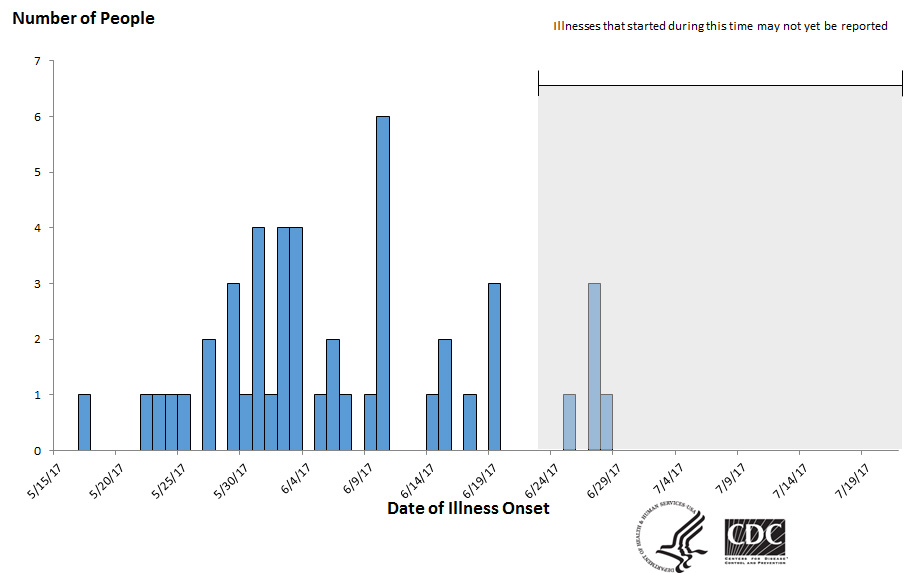
The Salmonella outbreak began in mid-May. As of July 21, 2017, CDC has received 47 confirmed reports of Salmonella Kiambu infections from twelve states, including: Iowa (1), Kentucky (1), Louisiana (1), Maryland (5), Massachusetts (1), Minnesota (1), New Jersey (12), New York (13), Pennsylvania (4), Texas (1), Utah (1), and Virginia (6). Twelve of the outbreak victims required hospitalization. The death was reported from the New York City area.

The MDH Laboratories Administration tested Maradol papayas obtained at a retail location in Baltimore, finding Salmonella in three out of five samples, including the Salmonella Kiambu outbreak strain as well as Salmonella Thompson.

Some illnesses have been reported in states where Grande Produce did not distribute the Caribeña papayas. FDA is continuing its investigation as it is possible the contamination may not be restricted to the Caribeña brand.

CDC offers the following advice to consumers, restaurants and retailers:

CDC recommends that consumers not eat, restaurants not serve, and retailers not sell Maradol papayas from Mexico until we learn more.

  • At this time, Caribeña brand papayas from Mexico have been identified as one brand linked to the outbreak. Additional brands will be announced as the information becomes available.
  • Maradol papayas have a green skin that turns yellow as the fruit ripens.
  • A sticker on the Maradol papaya should say if the papaya is Caribeña brand and if it is from Mexico.
  • If you aren’t sure if the papaya you bought is a Maradol papaya from Mexico, you can ask the place of purchase. Restaurants and retailers can ask their supplier.
  • When in doubt, don’t eat, sell, or serve them and throw them out.
  • Wash and sanitize countertops as well as drawers or shelves in refrigerators where papayas were stored.