

In 2023, the US Food and Drug Administration (FDA) inspected three Nestlé Purina production facilities. All three manufacturing plants produce Purina ProPlan pet foods in addition to other brands owned by Nestlé Purina.
While the inspections predate the current concerns raised by pet owners regarding Purina ProPlan, the reports shed some light on the manufacturing and quality assurance practices at these locations.
Clinton, Iowa
This facility manufactures extruded dried kibble and extruded treats under several brand names, including: Pro Plan®, Nestlé Purina ONE Beyond®, Nestlé Purina Veterinary Diets®, and Beggin®.
On February 8, 2023, Nestlé Purina announced a recall of Purina Pro Plan Veterinary Diets EL Elemental dry dog food due to “potentially elevated levels of Vitamin D.” The recall covered seven production codes.
Approximately one month later, on March 10, 2023, the company expanded its recall to include two additional production codes.
The recalled products were manufactured in Clinton, Iowa, using a vitamin pre-mix supplied by ADM Nutrition.
ADM is a self-described “… global leader in human and animal nutrition…” with net sales in 2020 of $64 billion.
On February 14, 2023, less than one week after the initial Purina recall announcement, the FDA began a three-day long inspection of the Clinton manufacturing facility.
The investigators reviewed the company’s Hazard Analysis for the recalled product, noting that it identified nutrient (including vitamin D) toxicity and deficiency as hazards likely to occur.
Nestlé chose to apply what is referred to in the inspection report as a “supply chain preventive control” for this hazard. The control consisted of obtaining the vitamin pre-mix from a third-party supplier (ADM Nutrition).
Nestlé did not test either the pre-mix or the finished pet food to ensure that the Vitamin D level was correct.
The conclusion of the FDA investigation team was clear and unequivocal.
The failure to test the inbound pre-mix, the failure to test the finished Purina Pro Plan Veterinary Diets Elemental (PPVD EL) prescription dry dog food, and/or the lack of any other appropriate monitoring or verification steps resulted in your release of the product to the public. These vitamin D levels were up to 77 times (103 IUs/gram versus 1.33 IUs/gram) your expected levels. The consumption of these released lots of product resulted in animals needing veterinary care, and subsequently resulting in your recall of the product.
FDA Establishment Inspection Report (FEI #1924965) for Nestle Purina Pet Care Co., Clinton, IA (February 14-17, 2023)
Although the inspection result ultimately was categorized as “Voluntary Action Indicated,” no formal Inspectional Observations report (Form 483) was issued.
On March 13, 2023, the FDA began a four-day inspection of the ADM Nutrition plant that had supplied the pre-mix to Nestlé.
The investigation team found that ADM’s “prerequisite program” had been inadequate to prevent a wrong ingredient from being added to the pre-mix that was supplied to Nestlé. ADM did not test the pre-mix before supplying it to the Clinton plant.
According to a Warning Letter issued on October 23, 2023, ADM had no preventive controls in place to mitigate the risk of error.
Once again, the FDA’s conclusions were unequivocal.
[T]he findings of elevated levels of vitamin D in several lots of your AA Diet preblend indicate your prerequisite programs were insufficient or you failed to implement them adequately to ensure the inclusion of vitamin D did not result in a nutrient toxicity.
FDA Warning Letter (CMS Case #657846) issued October 23, 2023
Crete, Nebraska
This location manufactures Alpo®, Nestlé Purina ONE®, Pro Plan®, Friskies®, and Nestlé Purina Veterinary Diets® canned dog and cat foods.
On December 2, 2022, the company announced a recall of a “limited amount of Purina Pro Plan Veterinary Diets EN Gastroenteric Low Fat” due to what it described as a labeling error.
On June 27, 2023, the FDA began a three-day inspection of the facility as a follow-up to the recall and to seventeen consumer complaints received by the agency between 2018 and 2023 about foods manufactured at the Crete location.
During the inspection, the FDA investigator learned that the mislabeling of cans was due to a can conveyor motor malfunction. The stoppage of the conveyor line caused sealed cans to accumulate, forcing a diverter gate to open and allowing the comingling of two different products—a cat food and a dog food—prior to the retort (pressure cooking step).
Although the recall notice cited a simple mislabeling, the risk was more serious. According to the inspection report, the “…inadvertent diversion of the product prior to retorting led to the product receiving the incorrect thermal process.”
The consumer complaints included presence of foreign objects, pet illness or injury, and off odor/appearance.
The inspection report notes that the plant did not identify foreign material as a hazard requiring a preventive control, but relied on magnets to detect and remove metal objects from the in-process pet foods.
The investigators also observed problems with the plant’s control of residual chlorine in cooling water.
When cans of food leave the retort, they pass immediately into a water-filled cooling canal. The water is chlorinated to prevent growth of microorganisms, including both bacteria and yeasts.
As the cans cool, a partial vacuum forms inside, which can result in a small amount of cooling water being sucked in.
If the water is not sufficiently chlorinated, live bacteria and yeasts can be carried into the cans. These might be spoilage microbes, or even pathogens.
According to the inspection report, although the cooling water was monitored regularly for chlorine, corrective action was not always taken when the chlorine level fell below the target specified in the company’s food safety plan.
Although these observatons were discussed with management at the close of the inspection, no formal Inspectional Observations report (Form 483) was issued, and the inspection result was classified as “No Action Indicated.”
Edmond, Oklahoma
This location produces extruded dry pet food for dogs, puppies, cats, and kittens under nine brand names: Friskies, Cat Chow, Kit N Kaboodle, Kitten Chow, ONE, Alpo, Beneful, Dog Chow, and Pro Plan.
On April 11, 2023, the FDA conducted a routine inspection of the Edmond location, to review the firms Food Safety practices and discuss a total of six consumer complaints received since the previous inspection in 2019.
Unlike the situation in Clinton and Crete, the inspector found no deviations or deficiencies in the Edmond operations.
The plant uses a supply chain control program that includes pre-requisite approval of all suppliers by the Nestlé Purina corporate office. The plant also submits samples periodically to the corporate lab for nutritional analysis.
The Food Safety Plan uses a single Critical Control Point (“kill step”) for all of its products: extrusion time/temperature. Finished product is tested for Salmonella before being released for distribution.
The inspection was classified as “No Action Indicated.”
Other Nestlé Purina locations
Two other locations—Denver and Flagstaff—also manufacture Purina Pro Plan pet foods.
Flagstaff, Arizona
The Flagstaff production plant was last inspected in 2019. It produces dry, extruded pet food under the following brands: Dog Chow®, Beneful®, Nestlé Purina ONE®, Alpo®, and Pro Plan®.
Although no Form 483 was issued at the completion of the 2019 inspection, four deficiences were discussed with management:
- Inadequate control to minimize the risk of metal foreign object contamination
- Written food safety plan was not revised to reflect significant change in activities
- Large gaps in seals around overhead doors in multiple locations
- Plastic wrap being used as a seal in an air system.
Two of the four issues were corrected and verified before the close of the inspection, and the inspection was classified “No Action Indicated.”
Denver, Colorado
Denver was last inspected in 2018. The location produces pet food under the following brands: Dog Chow®, Cat Chow®, Kit n Kaboodle®, Alpo®, Beneful®, Nestlé Purina ONE Beyond®, Nestlé Purina ONE®, and Pro Plan®.
The 2018 inspection was classified as “No action indicated.” eFoodAlert has requested, but has not yet received, the Establishment Inspection Report for this inspection.
Some take-aways
FDA Form 483. Inspectional Observations
According to the FDA’s Investigations Operations Manual, a Form 483 should be issued “…when in the investigator’s judgement, conditions or practices observed indicate that any food, drug, device, or cosmetic has been adulterated, or is being prepared, packed, or held under conditions whereby it may become adulterated or rendered injurious to health.”
This may (and should) include issues such as elevated mycotoxins, presence of pathogens (such as Salmonella), and toxic levels of Vitamin D in pet foods.
It is also arguable that multiple instances of inadequate control of can cooling water should trigger issuance of a Form 483.
Nestlé Purina is not a monolith
In reading the various Establishment Inspection Reports, it becomes clear that while the corporate office provides some direction, each manufacturing location has at least partial autonomy over its operations and food safety decisions.
The Clinton location made no attempt to test either its pre-mix ingredient or its finished products for Vitamin D levels, relying solely on ADM to provide the specified formulation. In contrast, the Edmond plant submitted periodic samples to the corporate lab for nutritional analysis.
Supply-chain preventive control
There are multiple references to supply-chain controls, which boil down to relying blindly upon one’s suppliers to provide a product that meets all specifications.
The Clinton experience with faulty pre-mix supplied by ADM is a glaring example of how dangerous this practice can be. A simple, routine test of each batch of pre-mix would have prevented the release of multiple production lots of toxic pet food.
A Final Word
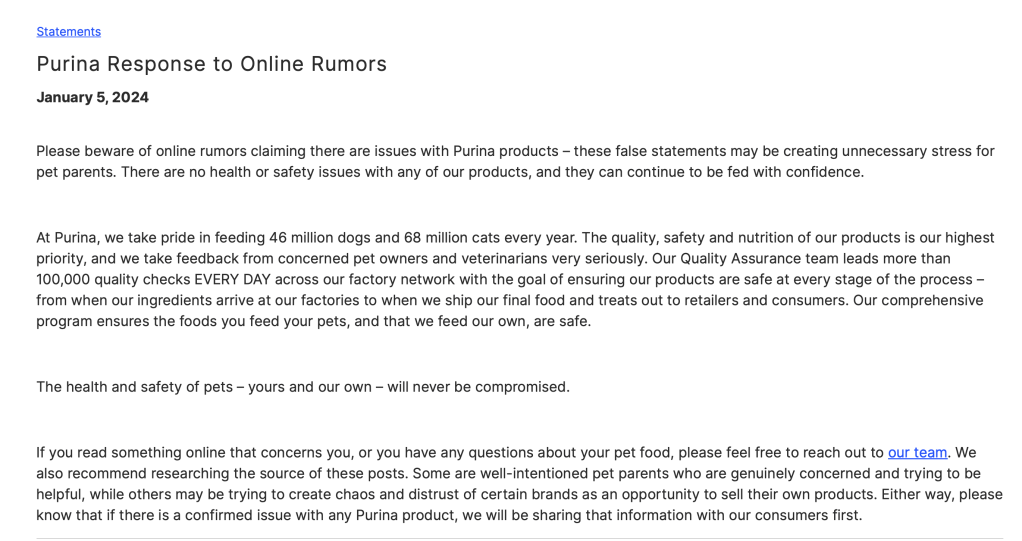
In January 2024, eFoodAlert reported on an alarming number of consumer complaints about pet illnesses and deaths that appeared to be associated with Purina pet foods.
An FDA investigation into these illness reports is ongoing.
If you or your veterinarian believe that your dog or cat has been injured in any way by a commercial pet food or treat, the FDA wants to hear from you. Visit the FDA web page, How to Report a Pet Food Complaint for a detailed explanation of how to file a complaint.
The Establishment Inspection Reports issued by the FDA and referenced in this report were obtained in response to Freedom of Information Act requests.

“A complete and compelling account of the hidden and not-so-hidden ways the food we give our beloved pets can be contaminated.” – JoNel Aleccia, Health Reporter, Food & Nutrition, The Associated Press.
“An invaluable resource for busy pet owners” – Food Safety News
Available from all major on-line retailers, including:



 eFoodAlert