Post From The Past. Say Raw Milk Cheese, Please!

First posted on October 12, 2009

To visit France is to experience cheese in its infinite variety of aromas, flavors and textures.

The French take their cheese seriously, and frown on the North American practice of using pasteurized milk to make cheese. Indeed, European cheeses that wish to boast a “Protected Denomination of Origin” – the cheese equivalent of wine’s “Appellation d’Origine Contrôlée” – must be manufactured from raw milk.

The US Food and Drug Administration permits the manufacture and marketing of hard cheese made from raw milk, if the cheese is aged at a temperature of at least 35ºF for no less than 60 days. Blue, brick and cheddar are a few of the cheeses that fall into this category.

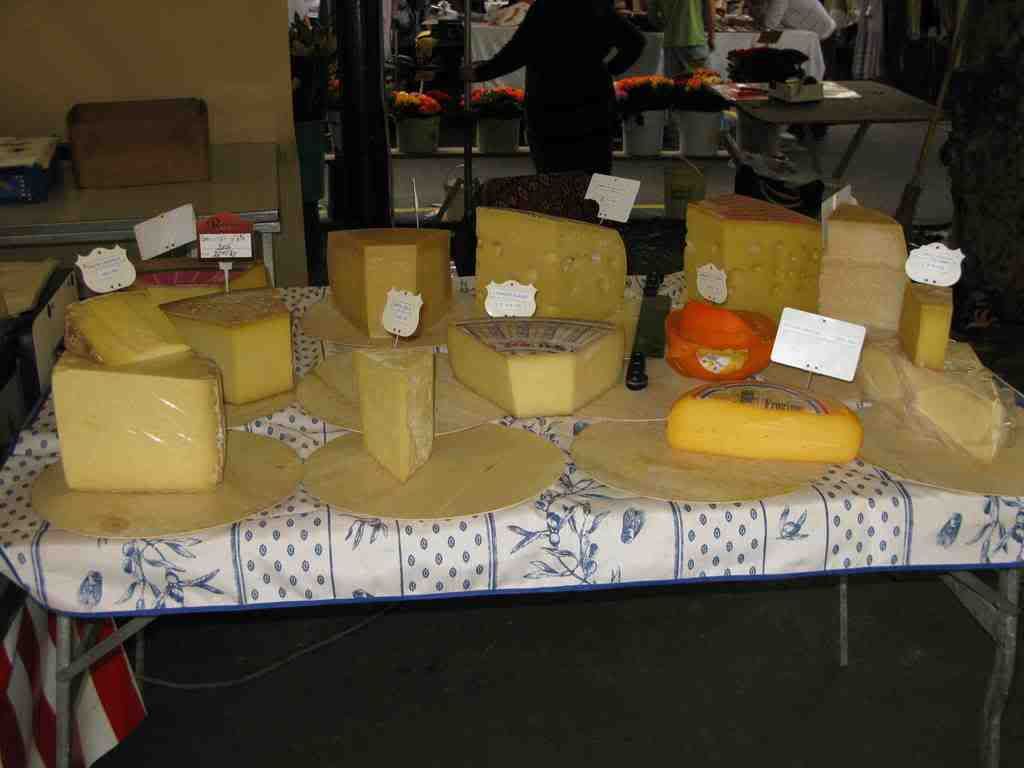
Point Reyes Farmstead Cheese Company was just one of the raw milk-blue cheese producers on display at the San Francisco Farmer’s Market during our visit last month. The company makes its cheese exclusively with milk from its own herd of Holsteins. The cheese-making process begins within a few hours after milking, and the cheese is allowed to age for six months – well beyond the 60 days required by FDA.
But,” you ask, “What about Listeria monocytogenes, Salmonella and E. coli? Is raw milk cheese as safe to eat as cheese made from pasteurized milk?

According to Dr. Catherine W. Donnelly, University of Vermont Professor, Listeria monocytogenes expert, and co-Director of The Vermont Institute for Artisan Cheese(“VIAC”), the answer is “Yes” – as long as cheesemakers are educated about how to ensure the safety of their raw-milk products.

VIAC offers Beginning and Advanced Cheesemaking Certificate programs, which include a course on Hygiene and Food Safety In Cheesemaking, and one on Risk Reduction Practices. The Institute also conducts ongoing research, including programs onCheese Microbiology and Safety and Milk Quality.

Vermont and California are not the only states taking a hard look at hard cheeses made with raw milk. Maryland recently introduced a pilot program to encourage the production of raw milk cheeses on a few farms in the state. Pennsylvania, too, encourages an artisan cheese industry.

But don’t expect FDA to expand its acceptance of raw milk cheeses beyond the hard cheese varieties. Recent research carried out by Dr. Donnelly and her University of Vermont colleagues showed that Listeria monocytogenes can grow on aged soft cheeses (e.g., Brie and Camembert). This is true regardless of whether the cheeses were made using pasteurized milk or raw milk.

Sticking to pasteurized milk for the production of soft cheeses reduces the risk of pathogens in the raw ingredients and, therefore, in the finished cheeses. Nevertheless, Listeria monocytogenes, which is found just about everywhere in the environment, can contaminate the cheese after it is made.

What does this mean for the consumer? Simply, anyone who is elderly, very young, pregnant, or suffers from a weakened immune system for any reason, should avoid eating soft cheeses – especially those made from raw milk. Hard cheeses that were made from fresh milk of high microbiological quality and held at 35ºF for 60 days or more, are far less likely than soft cheeses to support growth of bacterial pathogens.

The insertion of sound science into the cheesemaking process by organizations such as VIAC is good for both the dairy industry and the consumer. If we continue along this path, the United States will someday be able to rival its European cousins in the art and science of artisan cheesemaking. As you can see, we’re already not doing too badly.

Some of the information contained in this article came from the following source:

D’Amico, D.J., M.J. Druart, and C.W. Donnelly. “60-Day Aging Requirement Does Not Ensure Safety of Surface-Mold-Ripened Soft Cheeses Manufactured from Raw or Pasteurized Milk When Listeria monocytogenes Is Introduced as a Postprocessing Contaminant” in Journal of Food Protection, vol 71(8): 1563–1571. 2008.


Post From The Past. Restaurant Inspections: Does Publishing The Results Do Any Good?

First posted on October 8, 2009

On our recent trip to San Francisco, my husband and I stayed at the Union Street Inn, a Bed and Breakfast located in the Cow Hollow district. We chose the Inn based on its excellent reviews on TripAdvisor.com.

When we presented ourselves at breakfast the morning after we arrived, I was delighted to see that the Inn had achieved a score of 100% on its most recent food service inspection. But – even though I am a food safety microbiologist – it hadn’t occurred to me to look into the food inspection history of the Inn before we made our reservation.

Most cities and counties in the developed countries carry out some form of routine restaurant inspection. Many local health departments post these inspection results on their web sites. Some jurisdictions – San DiegoLos Angeles and many counties in the United Kingdom, for example – go farther, and require that restaurants post their most recent inspection score on or near the front door (known as “Scores on Doors”). And a few agencies – including New South Wales, Australia – take the “Name and Shame” approach, publishing the names of food establishments that fail inspection.

Surprisingly, San Francisco does not require its restaurants to post their inspection scores. Instead, consumers must visit the web site of the San Francisco Department of Public Health to learn how their favorite restaurants stack up.

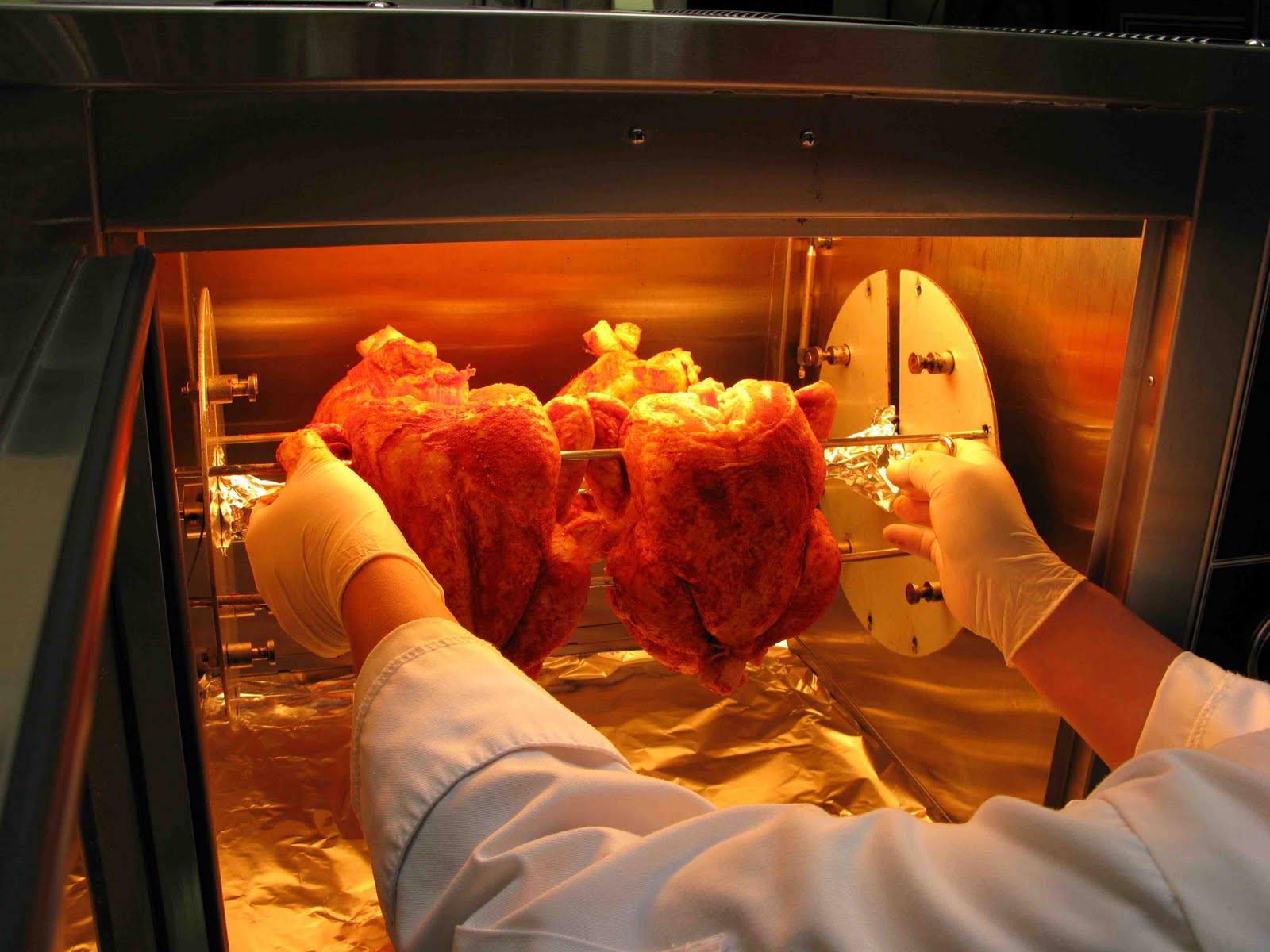
We stopped in at The Real Food Company, a local market and deli, for a snack one day.

I was favorably impressed with the care taken by a store employee in handling raw poultry as he loaded it into the rotisserie.

According to the San Francisco Department of Public Health, the store was inspected on September 3rd, just a few days before our visit. Real Food received an “A” rating, with a score of 90 points (out of 100). A score of 89 points would have meant a “B” rating. The inspector noted three violations – two “moderate risk” and one “low risk.” UPDATE: The store was last inspected on January 13, 2012, and “achieved” a score of only 81.

There has been a lot of on-line discussion recently on various food safety blogs about restaurant sanitation, “Scores on Doors” programs, and other food service issues. BarfBlog, in the United States and Le Blog d’Albert Amgar in France are both regular and responsible contributors to this topic.

I wonder, though, how many people take notice of restaurant inspection reports? Does anybody care?

Post From The Past. Free-Range, Organic, Air-chilled Poultry: Does Salmonella Care?

First posted on October 6, 2009

One of the stops we made at the San Francisco Farmer’s Market last month was Aimee’s Mountain Ranch Kitchen, where we learned the following about the Certified Organic poultry on display.

Last Thanksgiving, my husband and I opted for a locally raised free-range turkey in place of the our usual supermarket bird. I have to report that, while the local bird was tasty, it also was one of the toughest, boniest turkeys we had ever roasted. I guess you have to be tough to thrive in Vermont!

Although Aimee’s Mountain Ranch Kitchen does not claim that its Certified Organic, free-range, air-chilled chickens are microbiologically safer than conventional birds, some people believe that poultry raised and processed under these conditions is less likely to contain pathogens, notably, Salmonella and Campylobacter. Unfortunately, this is not so.

In 2005, researchers at the University of Maryland found that 76% of organic chickens and 74% of conventionally raised chickens available in retail stores contained Campylobacter.Salmonella was found in 61% of the organically raised chickens and 44% of the conventional birds. Similarly, in a University of Louisiana studySalmonella was recovered from 22% of conventional chicken carcasses in the Baton Rouge area and from 21% of organically raised chicken carcasses.

What about free-range vs. cage-reared birds? Don’t count on seeing any microbiological benefit here, either. Studies in the United States and Great Britain have shown that free-range birds are just as contaminated as cage-reared poultry.

Then, is chilling poultry carcasses in air any safer than by immersing them in cold water? Air-chilling sounds as though it would be less likely to foster the transfer of Salmonella andCampylobacter from a few contaminated birds to an entire batch of “clean” carcasses. But research studies published in 2003 and 2007 failed to substantiate this.

Nevertheless, there are some benefits to free-range, organic farming and air-chilling of poultry carcasses.

  • Water-chilling often results in 8-12% water (by weight) being retained by a carcass, according to USDA. This “retained water” must be declared on the label. Air-chilling eliminates the extraneous water that otherwise is added to poultry carcasses – water that the consumer pays for, since poultry is sold by weight.
  • While conventional and organically raised poultry don’t differ significantly in their level of Salmonella contamination, the University of Louisiana study (mentioned above) found that Salmonella recovered from conventionally raised birds was far more likely to be antibiotic-resistant.
  • Air-chilling reduces the amount of water used by poultry processors – a serious concern in drought-prone areas.

Because free-range and organic farming are more labor-intensive than conventional large-scale industrial farming, organic and free-range chicken tends to be more expensive. Whether the outcome of these artisan farming procedures is worth the added cost is a judgment that each consumer has to make.

Whether you decide to buy a conventionally raised chicken or a free-range, organic bird, remember to handle the carcass as though it contains Salmonella and Campylobacter.

  • Cook the chicken to an internal temperature of 165ºF, using a meat thermometer to verify the temperature;
  • Clean and disinfect all kitchen implements, cutting boards and counter tops that may have come into contact with the raw chicken;
  • Wash your hands thoroughly after handling raw chicken; and
  • Sanitize wet sponges and dishrags by microwaving them on the highest setting for at least 30 seconds.