Domestic Sprouts Behind German E. coli Outbreak?

Bean sprouts grown in Lower Saxony (that’s in Germany, not Spain) are the latest suspects in the month-long German E. coli O104:H4 outbreak.

BBC Europe reports today that the epidemiological spotlight has landed on a plant nursery in Uelzen, south of Hamburg.

The German Ministry of Health is waiting for the results of lab tests before committing to this latest theory. For now, authorities are maintaining a warning against eating tomatoes, cucumbers or lettuce.

Nevertheless, the nursery has been closed.

While the outbreak strain of E. coli O104:H4 is a novel strain, sprouts of various kinds – beans, alfalfa, broccoli, et cetera – have been the source of numerous documented outbreaks of Salmonella and E. coli in Europe, North America and Japan.

The conditions used to produce sprouts – a warm and moist environment – are ideal for the growth of bacteria such as Salmonella and E. coli. In many cases, the seeds used for sprouting are already contaminated with the microbes. And washing either the seeds or the raw sprouts will not remove the pathogens.

The German outbreak ranks as the deadliest recorded outbreak of enterohemorrhagic E. coli (EHEC)- and one of the largest. As of today (June 5th), 627 cases of hemolytic uremic syndrome (HUS), and a further 1,536 cases of “simple” EHEC infections have been reported from Germany. HUS is a life-threatening complication that is associated with EHEC infections.

Fifteen HUS patients have died in Germany, as have 6 of the outbreak victims who suffered from EHEC without HUS – an overall death rate of 0.97% (21 dead out of 2163 confirmed illnesses).

The outbreak has spread beyond the borders of Germany, with 31 cases of HUS (one death) and 71 non-HUS cases of EHEC (102 cases in all) reported from eleven European countries, including:

  • Austria.- 2 EHEC
  • Czech Republic.- 1 EHEC
  • Denmark.- 7 HUS; 11 EHEC
  • France.- 10 EHEC
  • Netherlands.- 4 HUS; 4 EHEC
  • Norway.- 1 EHEC
  • Poland.- 1 HUS
  • Spain.- 1 HUS
  • Sweden.- 15 HUS (1 death); 31 EHEC
  • Switzerland.- 3 EHEC
  • United Kingdom.- 3 HUS; 8 EHEC

All but one of the victims from these eleven countries reported having traveled to or from Germany during the typical incubation period for infection.

In addition to the European cases, the US CDC reports four suspect cases in the US – three of them suffering from HUS, and two suspect cases among US military service personnel in Germany.

Finding the source of the E. coli O104:H4 – if, indeed, the source has been found – won’t prevent the case count from continuing to rise. The incubation period, combined with the lab time required to complete a diagnosis, ensures that additional new cases will be reported. But the torrent should slow to a trickle over the next several days.

Even after the outbreak is over, this incident will fertilize numerous research projects. Still unanswered, for example, is why a disproportionate number of healthy women were stricken by HUS – a complication that more typically affects children. Questions about how this strain came into being, and why it is so deadly, also beg to be investigated.

Finally, expect the German people to question – rightly or wrongly – the competence of the epidemiologists and scientists at the Robert Koch Institute and the Federal Institute for Risk Assessment.

Germany’s Devastating E. coli Outbreak

The official numbers reported this morning by Germany’s Robert Koch Institut are worthy of a Hollywood thriller. Nine people dead, and 470 notified cases of hemolytic uremic syndrome (HUS) – a life-threatening complication of enterohemorrhagic E. coli infections.

The German outbreak data reported by BBC and others are even worse. Sixteen deaths, including one in Sweden; 1,534 infected with the outbreak strain known as E. coli O104:H4 – 470 of them suffering from HUS.

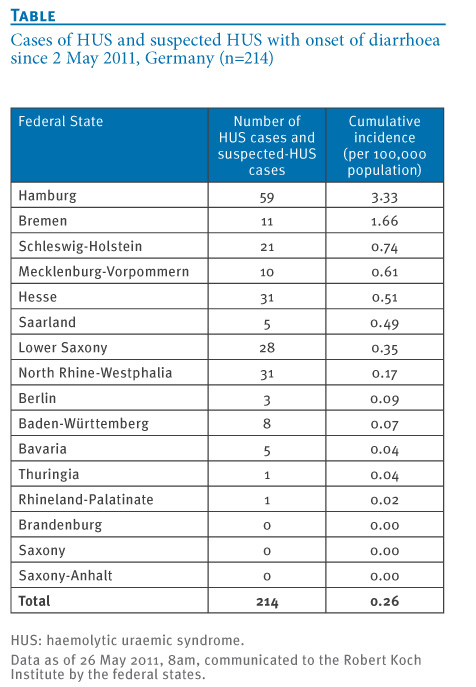
The outbreak began in Northern Germany; the heaviest concentration of confirmed cases – and of HUS – can be found in the states of Hamburg and Bremen. As of May 26th, thirteen German states had reported 214 cases of HUS – Hamburg (59), Bremen (11), Schleswig-Holstein (21), Mecklenburg-Vorpommern (10), Hesse (31), Saarland (5), Lower Saxony (28), North Rhine-Westphalia (31), Berlin (3), Baden-Württemberg (8), Bavaria (5), Thuringia (1) and Rhineland-Palatinate (1). These numbers already are far out of date, as the total number of cases has more than doubled since that report was issued.

Thanks to the ease of international travel – especially within the European Union, where most borders are invisible and undefended – the outbreak has not been confined to Germany. Eight other countries have reported confirmed or suspect cases of enterohemorrhagic E. coli in German nationals visiting their country or in individuals who reported having traveled to Germany:

  • Austria: 2 cases
  • Denmark: 14 cases, 6 with HUS
  • France: 6 cases
  • Netherlands: 7 cases, 3 with HUS
  • Spain: 1 case
  • Sweden: 41 cases, 15 with HUS and one death
  • Switzerland: 2 cases 
  • United Kingdom: 3 cases, 2 with HUS

Despite the best efforts of Germany’s epidemiologists, the source of this outbreak is unknown – except that it appears to be associated with consumption of raw tomatoes, cucumber and leaf salad.

For a time, suspicion fell on raw cucumbers imported from Spain – especially after lab analysis of two cucumber samples yielded enterohemorrhagic E. coli. But the cucumber contaminant did not match the outbreak strain.

The most frightening aspect of this outbreak, other than the lack of success in finding its cause, is the unusually high percentage of victims who have developed HUS – more than 30% of victims, as compared to the 5-10% HUS rate experienced in most other outbreaks.

HUS is a life-threatening complication, usually beginning with kidney failure and often progressing to failure of other organs and systems. Some 5-10% of HUS patients die, and most others suffer life-long consequences of their fight for survival – even with treatment. Conventional treatment consists of dialysis and, where necessary, plasma exchange.

The massive and deadly Canadian E. coli O157:H7 outbreak that was centered in Walkerton, Ontario in 2000 spurred Canadian researchers to study ways of preventing HUS – by preventing the bacterial toxins from binding to its target cells in the body. Researchers at the University of Maryland and in Argentina independently explored similar approaches – using monoclonal antibodies against the toxin in order to block its activity.

Just a few days ago, researchers in Canada, France and Germany reported that they used yet another antibody to treat successfully three 3-year-old children who were suffering from severe cases of HUS. But this new development might be too late to help many of the German outbreak victims.

The German outbreak has many unknowns:

  • What is the source?
  • What is the true number of illnesses?
  • Why is the incidence of HUS so high?
  • Why have adult women been disproportionately stricken?

And, most importantly, when will it end?