Darwin’s drags feet on pet food recall request—again

Arrow Reliance, Inc., doing business as Darwin’s Natural Pet Products (Darwin’s), has delayed acting on a request from the US Food and Drug Administration (FDA) to initiate a recall of three Salmonella-contaminated raw pet foods.

This information is contained in an August 16, 2023 FDA Advisory cautioning pet owners not to feed their pets certain lots of Darwin’s Natural Pet Products raw cat and dog food.

The FDA issued its advisory out of concern that pet owners might feed the contaminated products to their pets, warning that the Salmonella-contaminated products, “…pose a significant risk to human and animal health.”

The following three products, all of which have tested positive for Salmonella, were listed in the FDA notice:

  • Darwin’s Natural Pet Products Natural Selections Chicken Recipe with Organic Vegetables for Dogs, Lot 9774, manufactured on Jun 13, 2023.
  • Darwin’s Natural Pet Products Natural Selections Chicken Recipe for Cats, Lot 9795, manufactured on Jun 28, 2023.
  • Darwin’s Natural Pet Products Natural Selections Chicken Recipe for Cats, Lot 9830, manufactured on Jul 19, 2023.

Darwin’s has a troubled history dating back as far as 2016 with both the FDA and the Washington State Department of Agriculture (WSDA).

in 2016, the WSDA found Salmonella in a sample of a Darwin’s raw dog food.

In 2017, the FDA found both Salmonella and Listeria monocytogenes in a sample of Darwin’s dog food after a consumer complained that the product had made her dog ill.

In 2018, the FDA alerted the public to a “pattern of contamination” in Darwin’s raw pet foods after the agency found Salmonella, Listeria monocytogenes, and E. coli O128 in samples of the company’s products.

During a multi-day inspection of the company’s manufacturing facility in 2018/2019, the FDA found Salmonella and Listeria monocytogenes in the production environment, and also recovered Salmonella from finished product samples.

In 2022, in a follow-up to yet another consumer complaint, the FDA found two different Salmonella serotypes in samples of a Darwin’s cat food.

The inspections conducted in 2017/2018 and in 2022 both resulted in the issuance of a formal Warning Letter to the company.

In its response to the 2022 Warning Letter, obtained in response to a Freedom of Information Act request, the company simply refused to correct any of the violations listed in the letter.

In 2016/2017, Darwin’s quietly recalled several products, advising its customers of the recalls via direct email messages.

In March 2018, the company recalled four additional products after the FDA found Salmonella, Listeria monocytogenes, and/or E. coli O128 in samples of the items.

However, Darwin’s has not always been compliant with the FDA’s recall requests. As a result, the agency has released a total of four Cautions or Alerts for pet owners, including the most recent Advisory issued on August 16, 2023.

  • February 13, 2018:- FDA Investigates Pattern of Contamination in Certain Raw Pet Foods Made by Arrow Reliance Inc., Including Darwin’s Natural Pet Products and ZooLogics Pet Food
  • March 26, 2019:- FDA Cautions Pet Owners Not to Feed Their Pets Three Lots of Darwin’s Natural Pet Products Raw Dog Food Due to Salmonella
  • August 5, 2022:- FDA Cautions Pet Owners Not to Feed Certain Lots of Darwin’s Natural Pet Products Due to Salmonella
  • August 16, 2023:- FDA Advisory: Do Not Feed Certain Lots of Darwin’s Natural Pet Products for Dogs & Cats Due to Salmonella

The FDA has multiple enforcement tools in its arsenal. However, the most effective ones also tend to be the most difficult to implement.

When the FDA classified the results of its 2022 inspection at Darwin’s as “Official Action Indicated,” the tool it turned to was a formal Warning Letter, in which it set out a list of the violations observed during the course of the inspection and the company’s (lack of) substantive response to the requested corrections. The agency gave Darwin’s the standard fifteen (15) business days in which to respond with either proof of corrections or a written plan for making them.

Darwin’s simply declined to comply.

As this most recent FDA Advisory demonstrates, the Warning Letter was completely ineffective.

The FDA has the authority under the Food Safety Modernization Act to mandate a recall of a contaminated product that it believes to represent a hazard to human or animal health. It has exercised this authority sparingly over the years, preferring to obtain voluntary compliance on the part of a manufacturer.

Mandating a recall is not a trivial exercise. It requires several administrative steps, and can only be undertaken with the approval the FDA Commissioner, and after the company has been given written notice and one last chance to initiate a voluntary recall. At any stage in the administrative/notification process, there is a risk that the company will choose to seek an injunction to block the FDA’s action.

Under the Food Safety Modernization Act, all food facilities under the FDA’s jurisdiction must register with the FDA and renew their registration every two years.

The FDA has the authority to suspend a food facility’s registration, effectively shutting down its activities, if, “…food manufactured, processed, packed, received, or held by a registered food facility has a reasonable probability of causing serious adverse health consequences or death to humans or animals…”

While this would appear to be a very effective tool, Darwin’s has never registered with the FDA as a food facility, claiming that its direct sales business model and the fact that it does not distribute through a third party exempts the company from this requirement.

As indicated in the 2022 Warning Letter, the FDA disagrees with the company’s interpretation.

When a company demonstrates a pattern of behavior that flouts the laws and regulations under which every member of its industry is required to operate and declines repeatedly to comply with those laws, the ultimate tool in the regulatory arsenal is to petition the Court to order compliance.

The FDA was forced to follow this path in 2021 when faced with egregious acts of non-compliance on the part of Bravo Packing, Inc., a New Jersey-based producer of raw foods for companion animals and exotic (zoo) animals.

This is a costly and time-consuming process, and is viewed by the agency as a last resort.

The FDA Advisory offers the following advice to pet owners who may have purchased one of the recalled products.

  • If you have any of the Darwin’s Natural Pet Products Natural Selections cat or dog foods listed above, stop feeding it to your pets and throw it away in a secure container where other animals, including wildlife, cannot access it. 
  • Consumers who have had this product in their homes should clean refrigerators/freezers where the product was stored and clean and disinfect all bowls, utensils, food prep surfaces, pet bedding, litter boxes, toys, floors, and any other surfaces that the food or pet may have had contact with. Clean up the pet’s feces in places where people or other animals may become exposed. Consumers should thoroughly wash their hands after handling the product or cleaning up potentially contaminated items and surfaces.

There is no animal equivalent to the CDC. There is no mandatory reporting of animal illnesses. The FDA relies on voluntary reporting of pet illnesses by pet owners and veterinarians in order to spot potential outbreaks of animal illnesses due to contaminated pet food.

People who think their pets have become ill after consuming contaminated pet food should first contact their veterinarians. Veterinarians who wish to have pets tested for Salmonella may do so through the Veterinary Laboratory Investigation and Response Network (Vet-LIRN Network) if the pet is from a household with a person infected with Salmonella

The FDA encourages consumers to report complaints about pet food products electronically through the Safety Reporting Portal or by calling their state’s FDA Consumer Complaint Coordinators.


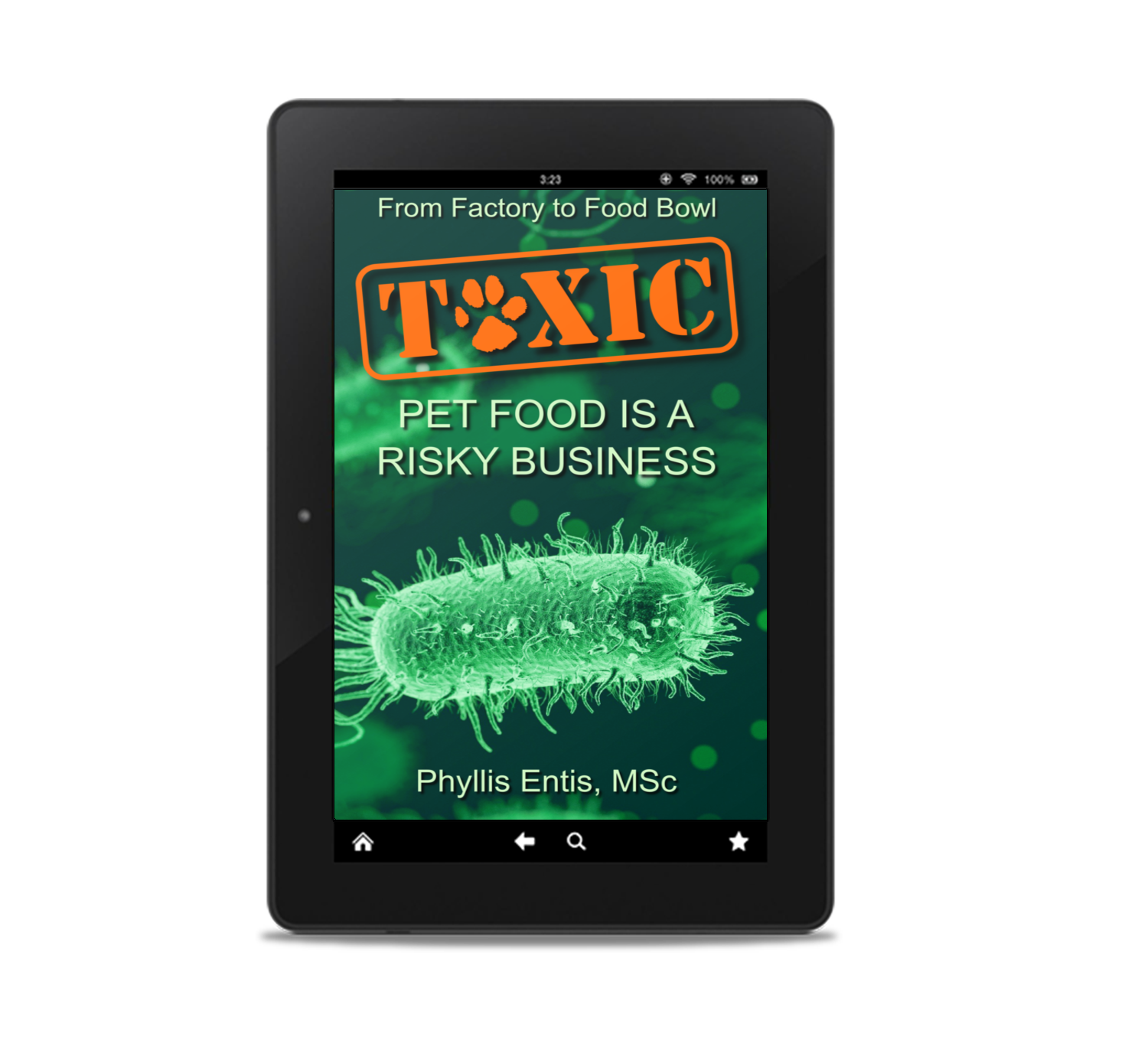
TOXIC

From Factory To Food Bowl
PET FOOD IS A RISKY BUSINESS

Learn more about the history behind the current Darwin’s issues, as well as the successes and failures of other pet food companies in the production of pathogen-free raw pet foods in TOXIC: From Factory To Food Bowl, Pet Food Is a Risky Business.

Available from all major on-line retailers, including:


Enjoy the slideshow as you listen to a sample of TOXIC, narrated by the author.

“A complete and compelling account of the hidden and not-so-hidden ways the food we give our beloved pets can be contaminated.” – JoNel Aleccia, Health Reporter, Food & Nutrition, The Associated Press.


Sunday Supplement: Darwin’s Defies FDA (Op-Ed)

In a written response to a February 16, 2023, Warning Letter issued by the US Food and Drug Adminstration (FDA), Gary Tashjian, President of Arrow Reliance, Inc. (dba Darwin’s Natural Pet Products) has effectively told the federal agency to take a hike.

Tashjian’s letter to the FDA was obtained by eFoodAlert in response to a Freedom of Information Act request.

The FDA Warning Letter was issued following an August–September 2022 inspection of the company’s raw pet food manufacturing facility, located in Tukwila, Washington, and the finding of two different Salmonella serotypes (Typhimurium and Kentucky) in samples of the company’s products.

In the Warning Letter, the FDA cited three violations of the Federal Food, Drug & Cosmetics Act and regulations (FD&C Act).

  • Adulterated animal food (due to presence of Salmonella)
  • Use of Peroxyacetic Acid (PAA) in a manner not generally recognized as safe under the FD&C Act
  • Failure to register as a Food Facility as required under the FD&C Act

Tashjian’s formal response characterized all of the FDA’s citations as “…arbitrary and capricious, in excess of statutory authority and otherwise unlawful.”

Tashjian’s arguments

Salmonella

The 2022 inspection that culminated in the Warning Letter was initiated in response to a consumer complaint. A cat owner had fostered four kittens, and fed about a tablespoon full of a Darwin’s adult cat food to three of them.

All three kittens who ate the food became ill, and a stool culture from one of the kittens yielded Salmonella. The kitten that did not eat the food remained healthy. Salmonella also was recovered from a sample of the same production batch that was fed to the kittens.

Over the course of the past several years, Tashjian has repeatedly rejected the FDA’s policy of zero-tolerance for Salmonella and other pathogens in pet foods and treats, including raw pet food products.

His argument is that the FDA must shoulder the burden of proof in each individual instance where a pathogen is found.

According to Tashjian, it is not enough to find Salmonella in one of his company’s finished products, even when the serotype in question annually makes the CDC’s list of ‘top ten’ Salmonella serotypes associated with human illnesses (as is the case with Salmonella Typhimurium).

Tashjian has taken the position that the agency must document that the quantity of the precise genetic strain of Salmonella found in the sample will cause illness in an animal or a person.

Tashjian’s response to the contamination cited in the Warning Letter is (a) that the strain of Salmonella recovered from the sick kitten was not typed genetically and may have come from somewhere other than the food, and (b) that the owner should not have fed the product to her kittens, as it was labeled for adult cats.

Use of peroxyacetic acid (PAA)

The FD&C Act and its associated regulations includes a list of food additives and ingredients that are “generally recognized as safe” (GRAS) for specific circumstances and at specific maximum concentrations.

Peroxyacetic acid, which is formed when acetic acid is allowed to combine with hydrogen peroxide, is GRAS for certain food applications, including as an antimicrobial secondary direct food additive in human food, at a maximum concentration of 220 parts per million (220 ppm).

Darwin’s uses PAA as a pathogen mitigation tool in its raw pet foods, even though the chemical has not been approved for that purpose, according to the Warning Letter. Furthermore, the company increased the concentration of PAA added to its products to an amount exceeding the 220 ppm that is permitted under the GRAS regulation.

And it did so without submitting any documentation that the level it is using is safe for dogs and cats to consume.

Tashjian’s rebuttal is two-fold.

  • PAA is used as a processing aid in USDA-inspected plants and any raw poultry purchased by Darwin’s would likely have been treated with this product.
  • The two components of PAA are both GRAS for pet food; therefore it is unnecessary for the combination of the products to be GRAS.

He is silent on the company’s use of PAA at a higher concentration than has been recognized as safe for any food applications.

Food Facility Registration

Finally, Tashjian rejects the FDA’s assertion that he is obliged to register Arrow Reliance, Inc. as a Food Facility, arguing that his company is exempt from the requirement, as it sells its products directly to consumers and is, therefore, a retail food establishment.

In support of his position, he cites the FDA response to comments published in the Federal Register concerning the definition of “retail food establishment.” (see Federal Register 81(135):45923. 14 July 2016)

My rebuttal

Tashjian’s cavalier dismissal of the risk to human and animal health associated with Salmonella-contaminated pet food is disingenuous, at best.

His stance on the presence of Salmonella (and other pathogens) in his raw pet foods is akin to a driver who, having been ticketed for doing 90 miles an hour in a 60 mile-an-hour zone, demands that the police officer provide proof that his speed was unsafe for that specific stretch of road in the specific make and model of vehicle under the exact time of day and road conditions at the moment he was ticketed.

Pathogens in pet food

The presence of Salmonella in any pet food or pet treat, raw or processed, presents a risk to human and pet health.

While not all Salmonella serotypes and strains are alike in their ability to cause infection, low numbers of Salmonella have been documented to do so, depending upon the susceptibility of the person or animal who is exposed to the microbe and the nature of the food ingested, especially the fat and protein content of the food.

As I discuss in my new book, TOXIC, Salmonella-contaminated kibble has been responsible for two multi-state Salmonella outbreaks in the United States since 2006. Salmonella-contaminated pet treats have caused multiple outbreaks of human illness in the United States and Canada since the 1990s.

Documenting Salmonella infections in animals is more difficult than in humans, because there is no requirement for animal illnesses to be reported to the FDA, even when a veterinarian has made a diagnosis based on lab culture results. Nevertheless, on two widely separate occasions (2017 and 2022), a direct link was established between a Salmonella-infected animal and a Salmonella-contaminated Darwin’s raw pet food.

Peroxyacetic acid as a pathogen mitigation

There is a process in place for a company to submit documentation demonstrating the safety and efficacy of a new food additive or a new use for an existing additive. The FDA reviews the documentation and if the data support the proposal, the agency will grant its approval.

That did not happen in this case.

Darwin’s arbitrarily and unilaterally increased the amount of PAA it adds to its products to a level beyond the highest concentration that had been approved as safe for any food application.

Food Facility Registration

Is Arrow Reliance really exempt from the requirement of food facilities to register with the FDA?

The exemption on which Tashjian bases his claim is a “retail establishment exemption.” According to Tashjian, because Darwin’s sells directly to customers, the company meets the definition of a retail establishment. He cites a specific statement made by the FDA and published in the Federal Register (volume 81(135), page 45923) to support his claim.

Tashjian quotes the statement as including in the exemption “…larger establishments [that] can reach consumers on a national level”

Read in isolation, the statement appears to support Tashjian’s contention. However, when taken in context, it is clear that the FDA is referring to “…direct-to-consumer sales of foods from local farms and establishments closely associated with farms.”

Arrow Reliance is not located on a farm, owned by a farm, or closely associated with farms. The company is a free-standing, independent manufacturer and processor of raw pet foods.

What next for the FDA?

Science, the law and common sense come down on the side of the FDA.

In my opinion, the agency has two choices:

  1. Continue along the well-trodden path of responding to future consumer complaints–and there will be future consumer complaints–with follow-up inspections, documentation of violations, and public alerts, all of which the company will either ignore or contest, or
  2. Solicit the assistance of the Department of Justice and apply for an injunction to compel the company to adhere to the same rules as every other raw pet food producer must follow.

If the FDA does not take strong action against Arrow Reliance, a company that routinely over the years has refused to cooperate with FDA and state investigators, has applied to the courts in a failed attempt to prevent the FDA from exercising its legal authority, and has ignored or deliberately misconstrued the clear intent of various provisions of the FD&C Act and regulations, the agency will lose all credibility both with the industry it is charged with regulating and with the public it is supposed to protect.


toxic-on-kindleWant to learn more about safety issues involving pet foods?

Pre-order TOXIC today for automatic delivery to your ebook reader on June 22, 2023.

Available from Amazon, Apple, Barnes & Noble, Kobo and Smashwords.

Sunday Supplement: Primal Pet ignores pathogen problem

Between August 2021 and August 2022, Primal Pet Foods, Inc.’s internal finished product testing program found forty-nine (49) pathogen-positive finished product samples, according to a Warning Letter released this week by the U.S. Food and Drug Administration (FDA).

Primal Pet Foods, Inc. (Primal) is a manufacturer of raw frozen and raw freeze-dried dog and cat foods, toppers, and treats based in Fairfield, California.

On July 6, 2022, Primal announced a recall of a single production lot of Raw Frozen Primal Patties for Dogs, Beef Formula (Lot #W10068709) after routine sampling by the FDA found Listeria monocytogenes in the product.

As a follow-up to the recall, the FDA visited the company’s Fairfield manufacturing facility on July 14, 2022, to begin an inspection that continued until October 11th.

During the course of the inspection, FDA investigators documented a large number of troubling issues

What the FDA found

The failures summarized in the Warning Letter and on the FDA Inspections Database include problems with preventive controls, supplier verification, record keeping, and inadequate monitoring.

Preventative controls that did not prevent pathogens

Primal’s food safety program includes adding a probiotic to its freeze-dried products as a preventative control for Salmonella.

Probiotics are so-called “good” bacteria found in the digestive system. They play an important role in digestion and also help to prevent pathogens from taking up residence in the large intestine.

When the FDA reviewed Primal’s documentation purporting to validate the effectiveness of the probiotic, they found significant flaws in the validation study, including the use of a relatively insensitive method for detecting residual Salmonella.

The FDA maintains a zero-tolerance policy for Salmonella and other pathogens in all pet foods, and the standard method used by government and industry labs is able to find a single living Salmonella cell in 25 grams of sample. Yet the method used by Primal’s lab to support their validation study was only able to find Salmonella if it was present at a level of 10 or more Salmonella cells per gram.

Furthermore, the company offered no evidence that its probiotic control would have any effect at all on other pathogens, such as Listeria monocytogenes or E. coli O157:H7.

As further proof that the probiotic control was not working, the FDA cited Primal’s own records of 49 pathogen-positive production lots over a one-year period. An average of just under one contaminated batch per week.

Inadequate response to contaminated and out-of-compliance products

Primal’s standard operating procedure specified a maximum level for Vitamin D of 3000 International Units per kilogram (IU/kg). Yet the company shipped a batch of freeze-dried dog food containing 3410 IU/kg–more than 10% above the maximum specified level. And it did so before the sample of this batch even reached its third-party lab for testing.

Primal’s standard operating procedure also specified a minimum level for thiamine–an essential vitamin for cats–of 5.6 mg/kg in its feline diets. Yet the company shipped a batch of freeze-dried cat food containing only 3.96 mg/kg. Again, the product was shipped even before the sample reached the lab.

Primal found Salmonella and/or Listeria monocytogenes in its finished products on 49 occasions during a one-year period, according to the company’s own records. There is no information in the Warning Letter as to what happened to those 49 contaminated production batches.

The only publically announced product recall occurred as a result of the FDA having found Listeria monocytogenes in a routine surveillance sample.

After learning of the FDA’s findings, the company issued a public recall. Yet it took no steps to evaluate the safety of other pet foods manufactured on the same production line immediately before and after the recalled batch.

Unhelpful response to records requests

Primal did not promptly provide all required records when requested to do so by the FDA investigator, impeding the ability of the FDA to complete its inspection and evaluation in a timely fashion.

It is unclear from the limited information available in the Warning Letter and the FDA Inspections Database whether or not the company eventually supplied all of the requested documentation.

What happens next?

The Warning Letter was dated February 21, 2023.

The company was been given the standard fifteen (15) working days following receipt of the letter in which to respond in writing with specific steps taken to correct the list of violations, including copies of related documentation to support its corrective measures.

The ball is now in Primal’s court.


toxic-on-kindleWant to learn more about safety issues involving pet foods?

Pre-order TOXIC today for automatic delivery to your ebook reader on June 22, 2023.

Available from Amazon, Apple, Barnes & Noble, Kobo and Smashwords.