
Post From The Past. Free-Range, Organic, Air-chilled Poultry: Does Salmonella Care?

First posted on October 6, 2009

One of the stops we made at the San Francisco Farmer’s Market last month was Aimee’s Mountain Ranch Kitchen, where we learned the following about the Certified Organic poultry on display.

Last Thanksgiving, my husband and I opted for a locally raised free-range turkey in place of the our usual supermarket bird. I have to report that, while the local bird was tasty, it also was one of the toughest, boniest turkeys we had ever roasted. I guess you have to be tough to thrive in Vermont!

Although Aimee’s Mountain Ranch Kitchen does not claim that its Certified Organic, free-range, air-chilled chickens are microbiologically safer than conventional birds, some people believe that poultry raised and processed under these conditions is less likely to contain pathogens, notably, Salmonella and Campylobacter. Unfortunately, this is not so.

In 2005, researchers at the University of Maryland found that 76% of organic chickens and 74% of conventionally raised chickens available in retail stores contained Campylobacter.Salmonella was found in 61% of the organically raised chickens and 44% of the conventional birds. Similarly, in a University of Louisiana studySalmonella was recovered from 22% of conventional chicken carcasses in the Baton Rouge area and from 21% of organically raised chicken carcasses.

What about free-range vs. cage-reared birds? Don’t count on seeing any microbiological benefit here, either. Studies in the United States and Great Britain have shown that free-range birds are just as contaminated as cage-reared poultry.

Then, is chilling poultry carcasses in air any safer than by immersing them in cold water? Air-chilling sounds as though it would be less likely to foster the transfer of Salmonella andCampylobacter from a few contaminated birds to an entire batch of “clean” carcasses. But research studies published in 2003 and 2007 failed to substantiate this.

Nevertheless, there are some benefits to free-range, organic farming and air-chilling of poultry carcasses.

  • Water-chilling often results in 8-12% water (by weight) being retained by a carcass, according to USDA. This “retained water” must be declared on the label. Air-chilling eliminates the extraneous water that otherwise is added to poultry carcasses – water that the consumer pays for, since poultry is sold by weight.
  • While conventional and organically raised poultry don’t differ significantly in their level of Salmonella contamination, the University of Louisiana study (mentioned above) found that Salmonella recovered from conventionally raised birds was far more likely to be antibiotic-resistant.
  • Air-chilling reduces the amount of water used by poultry processors – a serious concern in drought-prone areas.

Because free-range and organic farming are more labor-intensive than conventional large-scale industrial farming, organic and free-range chicken tends to be more expensive. Whether the outcome of these artisan farming procedures is worth the added cost is a judgment that each consumer has to make.

Whether you decide to buy a conventionally raised chicken or a free-range, organic bird, remember to handle the carcass as though it contains Salmonella and Campylobacter.

  • Cook the chicken to an internal temperature of 165ºF, using a meat thermometer to verify the temperature;
  • Clean and disinfect all kitchen implements, cutting boards and counter tops that may have come into contact with the raw chicken;
  • Wash your hands thoroughly after handling raw chicken; and
  • Sanitize wet sponges and dishrags by microwaving them on the highest setting for at least 30 seconds.

 

Post From The Past. San Francisco’s Other Chocolate Company

First posted on October 4, 2009

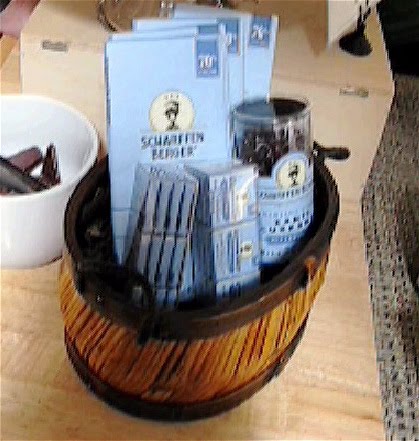
Located inside the Ferry Terminal building on the San Francisco Embarcadero is Artisan Confections, the retail home of San Francisco’s best kept chocolate secret – Scharffen Berger Chocolate Maker.

The company was founded in 1997 by Robert Steinberg and John Scharffenberger, with the aim of producing full-flavored dark chocolate using traditional methods, while controlling the process “from bean to bar.”

Scharffen Berger sources its own beans, working with cacao farmers in South American, Africa and Asia. While the company occasionally produces chocolate from a single source – at present, offering single origin chocolate from Ghana and from Vietnam – most chocolate is a blend of beans from different regions. The origin of the beans, together with the fermentation conditions and adjustments to the blend all contribute to the final flavor and texture of the finished chocolate.

Here is how Andrew McIntyre of Artisan Confections explained the difference between single origin and blended chocolate.

“You can deprive the body, but the soul needs chocolate.”

– Dagoba Organic Chocolate

Post From The Past. Probiotic Pickles

First posted on September 30, 2009

Probiotic: A microbe that protects its host and prevents disease. (www.medterms.com)

It doesn’t take much more than a stroll down the supermarket dairy case aisle to realize that probiotics are hot. A quick glance at the yogurt display reveals competing claims by two major international dairy brands, Dannon (Danone in France) and Yoplait.

Nor is the marketing of probiotic foods limited to the dairy industry. Even sour pickles are getting into the act, as we discovered during our recent stroll through the San Francisco Farmer’s Market.

The Happy Girl Kitchen Co. is a Central California packing company that specializes in preserving and packing local organic produce. The company sells its wares over the Internet as well as at Farmer’s Markets in Santa Cruz and in the San Francisco Bay area.

While the Company’s web site makes no probiotic claims for its dill pickles – or any other of its fermented products – the Happy Girl who we met at the Farmer’s Market told us the following:

Happy Girl is not alone in claiming health benefits for fermented dill pickles and other fermented non-dairy foods, such as sauerkraut and various ethnic pickled vegetables. A quick Google search turns up numerous blogsweb sites and other articles on the subject.

While some of the claims may be exaggerated, the fundamental principles are sound. Yogurts, other fermented dairy products (e.g., cheeses, buttermilk and kefir), pickles and sauerkraut result from the growth of lactic acid-producing bacteria – notably Lactobacillus. The benefits of consuming foods that have been fermented by lactic acid bacteria are several:

  • Lactic acid is a natural preservative
  • While growing, Lactobacillus produces compounds (known as prebiotics) that encourage the development of helpful bacteria in the intestinal tract
  • Many Lactobacillus bacteria produce natural anti-microbial compounds (known as bacteriocins) that act against pathogens such as Listeria monocytogenes
  • The presence in the intestines of probiotic bacteria – including many Lactobacillusbacteria – aids digestion and helps lactose-intolerant individuals to digest dairy-based products

Unfortunately, not all Lactobacillus are created equal. Not all strains produce effective bacteriocins. And some strains are better able than others to survive the harsh acid environment of the stomach and take up residence in the intestines. In a completely natural fermentation, there is no way to predict which strains of lactic acid bacteria will take charge.

Despite these caveats, the health benefits of prebiotics and probiotics are well established, and the role of Lactobacillus strains and other lactic acid bacteria in aiding digestion has been recognized for many years. And whether or not a particular batch of pickles contains a strongly probiotic Lactobacillus strain, it still can be counted on for some prebiotic benefits.

Happy Girl‘s customers can keep on smiling.